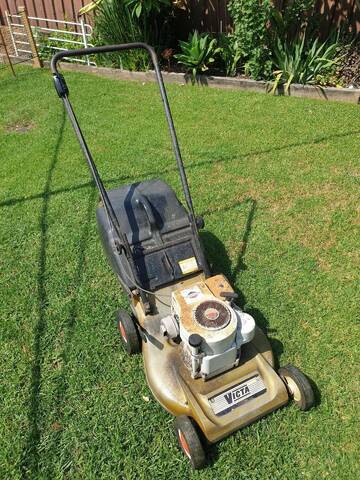
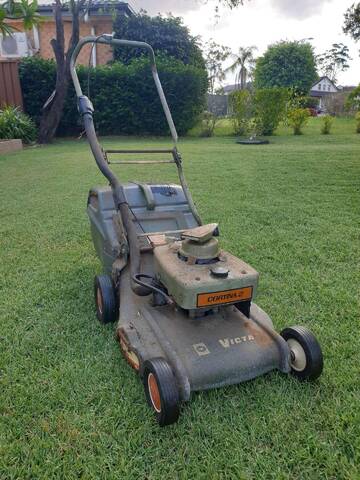
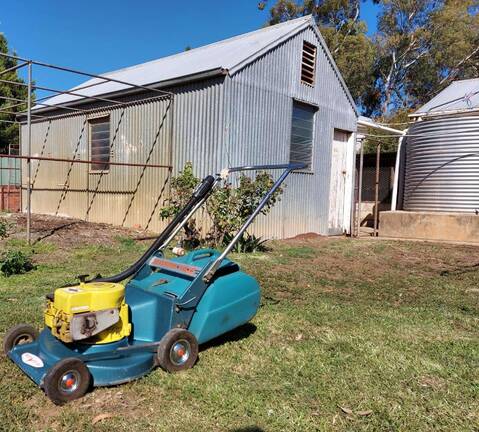
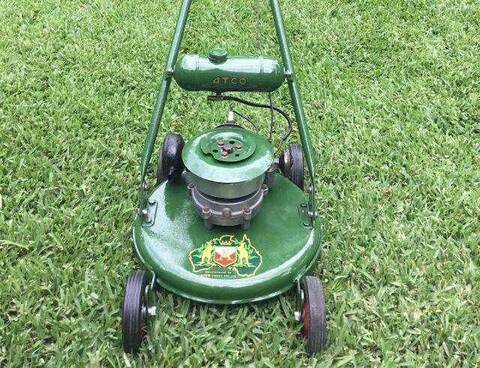
I have an add on Gumtree, Wanted Dead or Alive... Victas........Got a bite yesterday , had to pay $20, but that's ok for a boredom buster. Looked ok and original, motor turned over, no spark. Took the top off to ajust points, then good spark and compression, solid wheels. I cleaned up the flywheel, coil area and a bit of aluminium. I like to see a biit of shine..... Bodgied fuel tank, used electric start withy my drill... Started in a second, ran so smooth, quiet. Let it run for a few minutes then reved it a bit, responded well....... It's worth a paint job now....... Dissambled......... Now I just have to buy some black plastic and mollasses for the rust bath........ I'll decoke the rings , head etc....... At least I still have a job....... I think its a 1978 model.... by engine number.. I just posted all the pics to show newbies it's not that hard and it's extremly fun. cheers speedy
........................Keep your blades sharp......................
Speedy, they are a brilliant mower/slasher always worth $20 as long as the base isn't rusted through. You know how to fix the cup starters so they never slip?
G'day folks, Yep, that looks like a V196, 1977-80 model. Good jiggers - if the base isn't too rusted, as Norm says.
I have a slightly later side pull starter 160cc Mayfair Ute, and it has just a tiny rust hole or two, in the pressed ridge in front of the motor - I'm thinking of using metal filled epoxy putty for that repair, after grit blasting that bit back to bare metal.
Then do the rest of the underside with the wire cup brush, and give it a good brush coat of Bitumen paint - as I just might keep that one.
When I got it, it had new blades fitted - but wouldn't have cut for shite, there was that much of a clippings buildup under the deck. It came off in chunks!
Cheers, Gadge
"ODK Mods can explain it to you, but they can't understand it for you..."
"Crazy can be medicated, ignorance can be educated - but there is no cure for stupid..."
Gadge, I don't like the bitumen paint because if water gets in behind it it can just sit there and continue rusting. My favourite is give it a good clean and then paint it with fish oil. If you really felt the need, fish oil it, let it fully dry, some weeks at this time of the year, then give it a coat of bitumen paint
Good thoughts Norm, I have some fish oil on hand, too!
Was a cluey motor engineer mate's solution for preventing bike mufflers rusting out, back in the days of Leaded petrol. Recipe was to stand the muffler on end with the inlet plugged, fill it with fish oil and let stand 24hrs. Then pour off the oil, and let the muffler drain vertically for a few days. And do the other muffler/s with it in the meantime. After that, put them back on the bike, and go for a decent run.
You didn't want to be riding behind him for some time afterwards, though...
Cheers, Gadge
"ODK Mods can explain it to you, but they can't understand it for you..."
"Crazy can be medicated, ignorance can be educated - but there is no cure for stupid..."
Molasses rust bath I wanted to get a move on today, Couldn't buy a couple of mtrs of black plastic at Bunnings so bought a painters plastic drop sheet , ..... And the paint, I like it because petrol doesn't dissolve it when its dry...... Got a few weeks to work on the motor....... cheers speedy
........................Keep your blades sharp......................
Your local stockfeed or equestrian store (I suppose thats what you would call it) would probably have it in a useful size pail (normally 13-20kg in most cases I think)
I bought a several 1.25L of coles 'diet coke' for 25c or 35c a bottle - strips rust off almost as good as it rots teeth out haha
Black and gold white vinegar is also another alternative, as is electrolysis, but Molasses is probably the best
The local stockfeed/rural supplies joint here has Molasses in 5kg lidded buckets, too. 1+10 Molasses to water ratio has worked well for me also.
One tip: to make up the solution, weigh up the Molasses 1 or 2 kg at a time, directly into a standard 9L plastic bucket [most electronic kitchen scales will handle this total weight], then add water from the hot tap, and stir it up with a paint mixer in the leccy drill.
These 'drill paint mixers' are about $5 from Supercrap Auto.
Cheers, Gadge
"ODK Mods can explain it to you, but they can't understand it for you..."
"Crazy can be medicated, ignorance can be educated - but there is no cure for stupid..."
MF, 4 lts molasses to about 60 lts water 15:1. Got to get a piece of builders plastic, this is leaking............ speedy
Rural supplies joints often have thick black poly sheeting for fairly cheap too, for haystack/machinery coverings etc. Sold by the metre, and it's several metres wide, as I recall - the piece unfolds sideways, after it's cut from the bulk roll.
Cheers, Gadge
"ODK Mods can explain it to you, but they can't understand it for you..."
"Crazy can be medicated, ignorance can be educated - but there is no cure for stupid..."
Ok guys, now that I have the witches brew sorted, how long, four weeks? Can I pour the rubbish onto my lawn without murdering it?
Taking those in order, it's a bit of a 'how long is a piece of string' situation.
Depends firstly on how heavy the rust buildup is - and I strongly recommend removing all of the 'loose' rust mechanically, using a wire 'cup brush' on a 100mm angle grinder, before it goes into the molasses bath. [Do use appropriate PPE here - my getup is full face shield, long leather welders gloves, and a leather apron for this job - after having to pull a few busted off wire bristles out of myself...]
Secondly, this also depends on the ambient temperature - speedy will get much quicker results up in Bundaberg than us Mexicans will, at this time of year.
That said, you will have to pull the workpiece out of the solution regularly, hose/brush [an old dishwashing brush is what I use] it off on the lawn, and see how the job is progressing.
Weekly at a minimum, with sheetmetal parts - I forgot about a sheetmetal top from a Primus kero stove once, and made 'lacework' out of it... Fortunately, I had a NOS one in reserve.
Disposal - it's fine to pour the used solution down the municipal sewer system - there are no 'nasties' in it; that's one of the major advantages of this method.
A couple of caveats: 1. The bath needs to be covered up in operation; or insects, rodents etc will drown in it 2. Do not set it up in any enclosed building - it gets pretty stinky anyway
Cheers, Gadge
"ODK Mods can explain it to you, but they can't understand it for you..."
"Crazy can be medicated, ignorance can be educated - but there is no cure for stupid..."
I didn't have any spare buckets with clip-on lids [these will keep ants from getting in], so just grabbed the 'ready to go' size my local had on the shelf.
Molasses doesn't pour that easily down here, in cool weather. So I prefer to be able to pour it from a smallish bucket, with a long spatula in the other hand, to cut off the stream at the right point.
Cheers, Gadge
"ODK Mods can explain it to you, but they can't understand it for you..."
"Crazy can be medicated, ignorance can be educated - but there is no cure for stupid..."
Cripes Speedy ! what's the next step, wait for an electrical storm, insert the electrodes and see what sort of creature emerges from the goo ? happy smiley face.
When I did my engine cowl and went to clean it, rust would start appearing before your eyes as it was drying. I didn't know what to do about it so just painted it straight away as soon as it dried. It doesn't seen to have emerged anywhere so far.
Ahh, if only victa had kept producing the thumblatch catcher series, they would be in better shape today!
I do a bit of hand tool and parts refinishing, utilising a Molasses de-rusting bath, and a traditional 'rust blacking' process. This involves deliberately forming a uniform coat of red rust, Fe2O3, on the surface, and then converting it to 'black rust', aka magnetite, Fe3O4.
There are a couple of simple techniques to 'passivate' a reactive steel surface, after it comes out of any de-rusting bath.
The simplest is to treat the surface with boiling water - but you must use high purity water. Distilled or demineralised water is best, followed by rainwater. Tap water just doesn't cut it here; bore water even less so.
Pouring the water over the surface will work OK, if it's done straight away. The residual heat will ensure that the workpiece dries off quickly, too.
A related technique involves a 'steam cabinet' - tap water is fine to use in this one, as the workpiece never contacts the liquid water.
As I often work with longish, skinny workpieces, I've built a 'steam pipe apparatus' based on an old leccy frying pan, and some PVC DWV pipe and fittings. Pic of this setup attached; also a couple of refinished tools I've done. Rust blacked, then given a couple of coats of Boiled Linseed Oil - this is a good old-time anti-rust coating, and it doesn't stink fishily...
For an average thickness workpiece, 10-15min of steaming is all that is needed. Some of the 'black rust' is not bound to the metal, so this is removed in a process termed 'carding', using a soft wire brush or degreased steel wool.
Cheers, Gadge
"ODK Mods can explain it to you, but they can't understand it for you..."
"Crazy can be medicated, ignorance can be educated - but there is no cure for stupid..."
I have a hand held trigger steam cleaner that I use distilled water in. Is that useful?
If you mean one of those 'Steam Genius' type jiggers, then no. I have one of those here. Won't produce sufficient steam, or for long enough.
Edit: You'd need to use something like a pro type wallpaper steamer unit, as a steam generator. Something like the Andersen oil-fired industrial steam cleaner I used to have would ace the job, but be serious overkill!
Last edited by Gadge; 28/04/2005:18 PM. Reason: Elaboration
Cheers, Gadge
"ODK Mods can explain it to you, but they can't understand it for you..."
"Crazy can be medicated, ignorance can be educated - but there is no cure for stupid..."
with this pastime I spend minimal money, so there's two chances of obtaining one -non and Buckley's. It sounds like that is what I have. It cost me $20 at Aldi down from thirty something ninety nine.
I bet some dreamer on SleazeBay is attempting to sell one for $120.
Ahh, if only victa had kept producing the thumblatch catcher series, they would be in better shape today!
Yeah, I'm a dyed-in-the-wool scrounger, who does stuff on a minimal budget, too.
For bigger items like deflectors, it would be quite easy to set up a 'steaming chamber'.
Made from say a 20-60L steel drum with a clip-on lid, or just a loose cover of plywood or sheetmetal, and some sort of arrangement to keep the parts out of the water. Sit it on a decent [double ring or better] LPG ring burner, add a half bucket or so of water, and away you go.
The drum would need to be thoroughly degreased though, if it had contained oil or grease of any kind.
Cheers, Gadge
"ODK Mods can explain it to you, but they can't understand it for you..."
"Crazy can be medicated, ignorance can be educated - but there is no cure for stupid..."
I was tempted to leave the motor alone as it was running so well. Lucky I took head and barrel off as top ring was stuck in with carbon. I released it and decoke . It will be good as I will keep this mower for myself..... cheers speedy
........................Keep your blades sharp......................
Got to be patient, watch the paint dry and harden... I don't want to end up with scratches all over. I used Boston Black Zinc for cowl and black parts and underneath. Motor is almost ready. Looks like it had new rings, good bore , no lip. The cream plastic cover had sun degredation, it was powering, but not inside. I water blaster some stuff of and snaded and spayed some white paint on to fix it.... probably last longer than me... cheers speedy
Last edited by speedy; 09/05/2007:09 PM.
........................Keep your blades sharp......................







![[Linked Image]](https://www.outdoorking-forum.com.au/forum/ubbthreads.php/ubb/download/Number/12927/filename/IMG_0803a.JPG)
![[Linked Image]](https://www.outdoorking-forum.com.au/forum/ubbthreads.php/ubb/download/Number/12928/filename/IMG_0805.JPG)