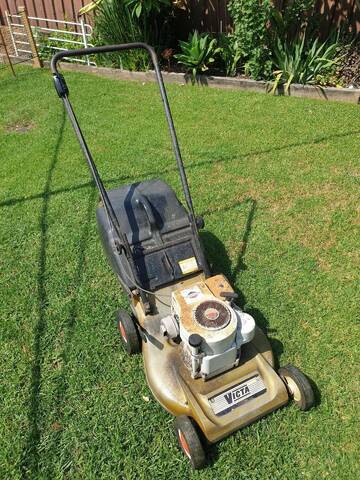
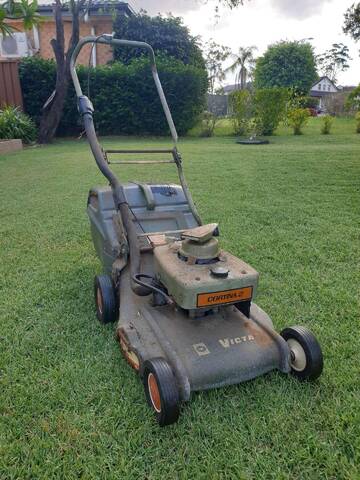
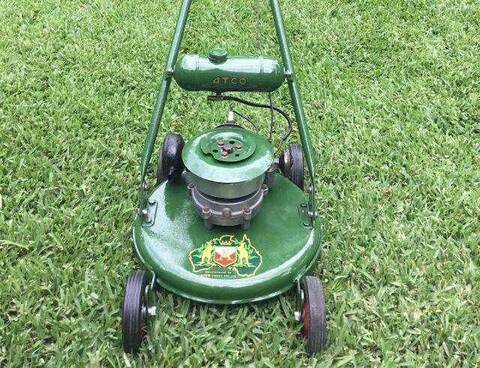
Picked up this 18 recently, had a search through the information here but there seems to be a lot of variations so I couldn't accurately place the model/year. It has a Victa Automatic handle bar plate but I can't see to much auto about it. The stamping on the lower crank case looks like a 1 but not on the right angle. It has the choke control on the air filter body. Maybe it's a bitsa ?
That one could well be a 'stripped Automatic' - i.e. one that has had the Automatic front/rear throttle control flaps and associated bits removed. It certainly has the [busted] extensions of the front and rear axle housings, that were unique to the Automatic. That would be because, back in the day, a common quickie method for removing the flaps was to just whack the flap pivot shafts with a hammer...
Have a close look at the carby top - the Autos had two throttle cable entries there.
If your machine actually left the factory as an Auto, one will have been plugged, if it's there. The Auto handle plate is a fairly strong indication, that this was likely the case.
Cheers, Gadge
"ODK Mods can explain it to you, but they can't understand it for you..."
"Crazy can be medicated, ignorance can be educated - but there is no cure for stupid..."
Thanks for the info, nothing visible on the very top of carby but there is a brass looking plug/screw about a quarter around toward the rear from the spring clip hole, is that what you are referring to ?
This Victa Special is a bitsa,it's from around 1959 to 1961 ,the engine number is from an earlier Victa Special.
This mower never had auto flaps the base does not have the alloy extensions to hold the flaps in but someone has installed the earlier axle locator brackets with the extensions for the flaps.
There are 2 types of auto badges ,the earlier badge is smooth alloy around the Victa Automatic the other badge has a rough texture on the plate.
Because this base has no edger slot it is the last of the Victa 18 alloy base mowers sold.
No substitute for experience regarding these older models, some great reading to be done on this topic, probably enough to get through another couple of pandemics. I have had some lube in the cylinder for a couple of days but no joy, engine is locked up like Fort Knox, might have to administer the last rights to this one.
What I'd do here, is to make up a brew of 50/50 by volume Acetone and Automatic Transmission Fluid [any type of ATF], and tip some down the spark plug hole - as much as will go in. Then prop the engine up, to keep the cylinder vertical, and leave it for a week or so.
This is a much favoured technique in the Vintage Engine Restoration community, for freeing up piston/bore seizures. And some of those engines come up OK, after decades of being seized...
Cheers, Gadge
"ODK Mods can explain it to you, but they can't understand it for you..."
"Crazy can be medicated, ignorance can be educated - but there is no cure for stupid..."
Ill give it a go, nothing ventured, nothing gained. I put a reasonable amount in and had it sitting on it's nose for a couple of days. Is it worth pulling the head off and having a look ?
+1 on the 50/50 Atf/Acetone - have heard of others using Diesel, but the 50/50 is just the best mix.
Gadge, quick question. I have got my new bottle of acetone ready for the next time I need it - last time I did it I just carefully mixed a little in a tin (as the acetone melts some plastics like PVC).
Do you know of anything safe to put it in that will act as a 'sprayer/applicator' of some description - I figure it would rot the seals out of a regular pump oil can
I don't know of any 'piston type' pump unit [outside of very exy 'lab gear grade' glass cylinder/Teflon piston dispensers] that can act as an applicator/sprayer for this mix - its solvent properties are just too aggressive.
The two simple items I have successfully used for 'localised squirt application' of it are these; 1. A small 5-20mL 'two-piece' hypodermic syringe - these don't have a rubber piston seal, but are hard to find, even for a labrat 2. HDPE 'transfer pipettes' - readily available via FleaBay for cheap, e.g. https://www.ebay.com.au/b/Transfer-Pipette-Pipettes/26417/bn_7037612639
wce, give the Acetone/ATF brew a go, before you pull the head - the acetone will not evaporate off as fast as it would from an open bore.
Cheers, Gadge
"ODK Mods can explain it to you, but they can't understand it for you..."
"Crazy can be medicated, ignorance can be educated - but there is no cure for stupid..."
Edit: I've done a bit of further research, and there aren't many 'rubbery' seal materials that can handle both the ATF and the Acetone. Elastomer types FFKM and ETP ; that's about it. And Teflon, but that's a lot harder material.
I also make use of a similar but less volatile mix, as a general 'penetrating lube/cleaner'. It's called 'Ed's Red', and was originally formulated for firearm cleaning. Simple recipe; equal volumes of Acetone, Kero, Mineral or Pine Turpentine, and any ATF. If you want a 'less aromatic' version, just use 'odour-free' Kero and Mineral Turps.
Last edited by Gadge; 24/04/2007:33 AM. Reason: Add seal info
Cheers, Gadge
"ODK Mods can explain it to you, but they can't understand it for you..."
"Crazy can be medicated, ignorance can be educated - but there is no cure for stupid..."