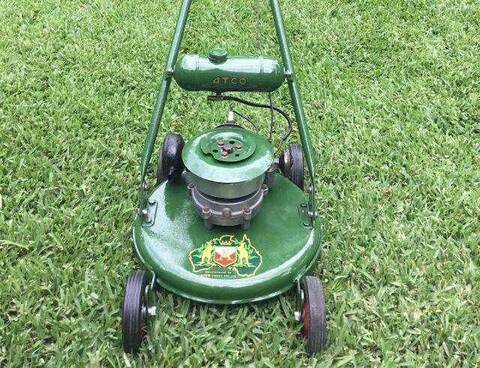
I'm guessing that your electric motor is the induction type. Most of these run at just under 1500 rpm (4 pole), and most of the exceptions to that run at just under 3000 rpm (2 pole). That speed is constant - full-load speed would be about 1440 rpm or 2880 rpm. If the mower still has the original chain sprockets (rather than having had a different-sized one fitted to the drive shaft from the clutch) its over-the-ground speed would probably seem moderately slow at 1500 rpm or moderately fast at 3000 rpm. I suggest you just check the sprocket sizes against your model 45; if they are the same, that is one less thing to worry about.
If it is an induction motor it is quite unlikely to be more than 1 hp if it is 1500 rpm or 2 hp if it is 3000 rpm: higher output motors are a bit uncommon for 240 Volt supply, and would be rather heavy as well. I doubt you have any need for more than 2 or 2.5 hp in your replacement petrol engine: cylinder mowers have higher cutting efficiency than rotary mowers, but are always self-propelled, which uses as much power as cutting the grass. Hence your Honda is far more powerful than necessary, but that doesn't matter. What does matter, is the engine's size and weight. I suggest you should not use a heavier engine than the original B&S or Tecumseh motor would have been, because it degrades handling, presses too deeply into wet ground, and can cause instability (mower tips over on slopes). The size issue relates to how you are going to mount the engine on the mower. You will need to make a set of specially-designed adaptors, so I hope you enjoy metalwork and have some facilities for doing it. Bear in mind that the alignment of the engine's output shaft with the clutch-to-sprocket shaft is critical, both for being on-centre and for being colinear. You will have to use a dial indicator to set up the engine: it is that critical. The other problem is one you have already mentioned: the engine-side of the clutch has to be adapted to the engine's output shaft. The shaft length is almost sure to be wrong, so you have a small engineering design project there as well.
The two jobs - designing and making adaptor engine-mounting plates, and designing and making a way to mount the clutch on the engine - are both within the capabilities of the average small engineering workshop (provided they have a lathe and a mill), but doing it with the required accuracy is getting pretty tough for a home handyman who has neither the machinery nor the skills. Most such projects I've seen worked out very badly: either abandoned, or final products that worked poorly and not for long. Have you considered looking around for an original engine, or at least an engine that uses the same mountings and has a similar output shaft? There are people on this board with a remarkable range of treasures in their back yards.
Concerning your last question, the engine's output shaft is part of its crankshaft, and I think it unlikely that Honda offers an alternative crankshaft that just happens to conform precisely to the dimensions of a B&S engine of half its size.