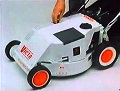
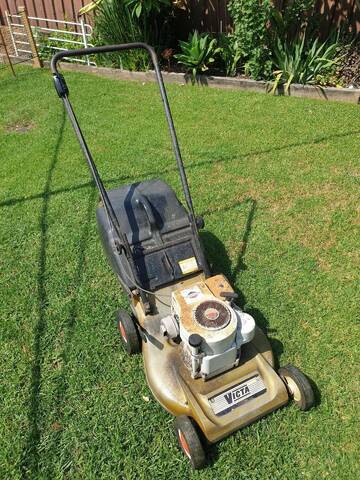
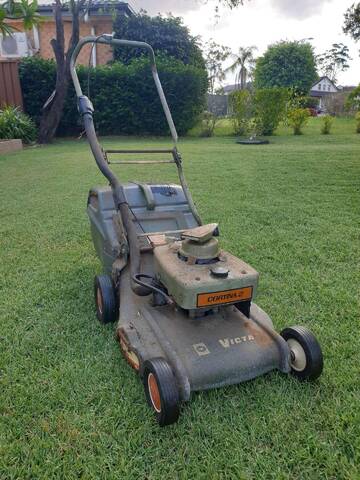
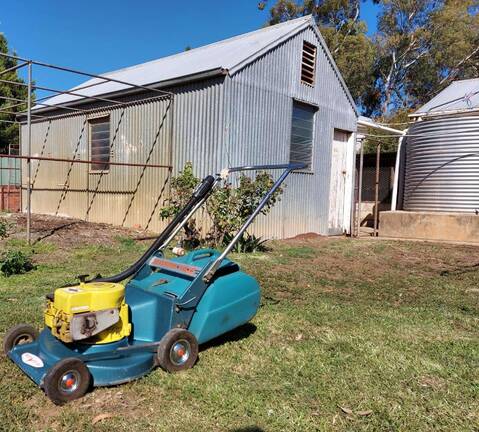
I'm hoping you'll be able to save my sanity! I've been working on a complete rebuild of a Victa Mulch or Catch MCA201G. The engine was in good condition so I didn't rebuild the internals, however I changed all gaskets and o rings. I've fully rebuilt the Carby, and I've cleaned and restored all the parts, every nut and bolt.
Now to the problem...
I started the engine on the weekend and it was over revving, so I adjusted the poppet valve and restarted it and it was idling beautifully.
I only had a small amount of fuel in the tank so it started to rev high before I killed it.
After that I couldn't get it to start... The starter cord would jam during the pull but it would still retract. If I pull it slowly it would turn smoothly.
I removed the engine and found that the magneto gap had completely reduced, and I think this was causing it to stick during the pull.
I re-adjusted the gap to 0.25mm using a feeler gauge, re-installed the engine and gave it another go.
This time it would pop, like a backfire, so I figured that the timing was out? But why? I pull engine out again and found that the gap had reduced again!!!
I have used anti seize on the bolts when re-assembling, I may have put too much and this is causing it to under tighten?? Not sure...
I've cleaned off all the anti seize and re gapped to 0.30mm. I re tightened as much as possible without breaking the bolts. I'll have to try again tomorrow, but I thought I should consult the experts before I go crazy!!!
Any ideas guys? Main symptoms are sticking mid pull (I feel like it is either pressure build up or magneto stopping fly wheel mid spin) and popping/bang during start. Also I don't have blade carrier installed.
Hi GT, you've solved your own problem in your last line. You must have the blade carrier fitted otherwise it wont start or run effectively. You need the added weight of the flywheel to maintain momentum when you pull the rope. Make sure it's done up tight. Cheers, Ted
I suspected this could be contributing to it, however does it explain the popping/misfire?
Is it because the momentum helps complete the stroke? And the timing is being thrown out due to it slowing when it generates the charge for the spark? I find that it stops in the same position when the magnet is near the ignition module and usually every second pull.
It's so sudden that the mower lifts off the front wheels.
Haha, appreciate your response Norm, would it misfire too? Can you tell me more about why this happens? Is it due to the added momentum required to complete the stroke?
You're right it did almost rip my finger off, I'm surprised that I didn't get any blisters.
What about the ignition module, have you ever had a gap reduce? Either from the module slipping or other reasons?
Not sure why the coil is moving, never had that problem, bolt that way up should be no problem. I assume you are setting the coil on the steel section of the flywheel, and 30 thou is a bit too wide, coil should not move if nothing is hitting it. Only other reason is it isn't tightened up properly, doesn't need too much just enough to hold it in position. Fix that problem, fit the blade carrier and then worry about the misfire. Out of curosity, was this motor running before you stripped it down?
When you say steel section of the flywheel, are you referring to the counter weight? I'm actually loosening the coil pack and then placing the flexible feeler in between the magnet and coil, then tightening while the feeler is in place. I then slide it out and re-check the gap. I think the anti seize was causing it to slip, I'll test it again when I get home tonight.
I have checked the spark and it is a nice bright blue spark, so I think I am setting the gap correctly.
Regarding the engine, I was told it was running, however it didn't start when I picked it up. Someone had cracked the plastic on the carb body where the plastic cover clips on, and there was an air leak. I did get it started for 30 seconds however it would run lean and cut out. So I replaced the carb body and now I'm trying to run it again.
It did start on the weekend, but once it ran out of fuel, I couldn't get it going again.
Ok if it has nice blue spark then it is a carby problem and that is another issue I have discussed elsewhere. I modify them so that they can be made to work fine with full throttle control. The kill switch is a pain in the neck though.This all depends on what you want this mower for, mowing lawns or putting it in a collection https://www.outdoorking-forum.com.au/forum/ubbthreads.php/topics/82291.html#Post82291 Top
One of the easiest ways I found setting most gaps is the use of a business card between the magnets and the coil legs as most are set very close .010" which coils are usually set at. Now .30mm is very close to .012" so that should be within the tolerance range though I don't know the specs on the Victa.
Also if the flywheel is hitting the coil legs check that the flywheel side crankshaft bearing/bushing doesn't have a lot play allowing it wobble as it turns. I have seen a few Briggs push mower engines with this problem.
Also there are places that the use of anti-seize will cause problem as you want the fiction of the fit to be there. Anti-seize also will throw off your torquing of bolts causing you to over torque them stripping threading.
Another update, I cleaned up the anti seize, and placed the Belleville washers in the correct way up. I set the gap to 0.30mm, and bolted on the blade plate. Even though I'm using the 0.30mm feeler, the 0.25mm feeler barely slides in, so there's not really much difference.
The jamming issue has been resolved, I have blue spark when testing the plug. Now it won't fire...
I'm going to strip the carb to make sure nothing moved while I was taking it on and off for the past few days.
I don't really know what else to do, other than check compression, but I'm pretty sure it's a tight engine.
Does it run momentarily with a squirt of ether (best known as these days as Start Ya Bastard!)? Of so. then it is the carburettor for certain. If not, then the starter assembly O ring or lower seal is probably at fault.
Ahh, if only victa had kept producing the thumblatch catcher series, they would be in better shape today!
If you follow the instructions I posted earlier regarding the carby modifications I guarantee it will start first pull. If you don't you are on your own as far as I'm concerned,I have modified countless numbers of these carbs now. Apart from that make sure the 3 screws holding the starter on are tight
AVB, just for your info, these motors only have bearings on one side of the crank, the top side of the crank is unsuported
Then it would like the half crank trimmer engine I work on here that uses one or two ball bearings to support the crankshaft, I'm assuming; could be wrong still learning something new everyday.
You said in your first post you had rebuilt the carb, I assume you cleaned the main jet? Yes AVB, they are a half crank, if I get a chance I will post a pic of one
Then it would like the half crank trimmer engine I work on here that uses one or two ball bearings to support the crankshaft, I'm assuming; could be wrong still learning something new everyday.
I cleaned the main jet when rebuilding carb, and just checked it again, all good.
I replaced the starter O-ring when rebuilding.
According to the Gregory's workshop manual, the gap should be set to 0.13mm-0.20mm, so just to rule it out, I re-gapped to 0.15, checked the spark, even better than before. Still not firing.
Where should I spray the ether?
Regarding the 2 stroke engine, I refuse to mow my lawn with anything else... I still use my parents old Craftsman Deluxe which doesn't miss a beat, but I want to retire it for a full restoration. I also bought one of the last 2 Stroke Mustangs, but that is staying in the box (don't tell the Mrs that!).
I'm at a loss, I'm wondering if the misfiring did some damage. At this point I'm going to finish the assembly and take some photos before it gets damaged, intentionally or otherwise
NormK, before I hack away at the carb and cam, anything else I can try to rule things out? It really shouldn't be this difficult unless something is seriously wrong.
I have another running mower, so I might try swapping the carb and give it a go.
I conducted a Compression Test as per the instructions in the Gregory's Workshop Manual. I compared the feel of resistance to my other working mower, this engine felt slightly tighter, but this is just feel...
So I decided to rule out the carb once and for all... I started my running mower to confirm that it is running, then I swapped my carb with throttle attached and fuel tank, plus decompression valve to the running engine. Prime and pull, boom, it is purring like a wildcat. It idles perfectly in 3 throttle positions, no issues with carb, fuel tank, air intake/throttle or decompression valve.
It seems like an issue with the engine itself. I'm tempted to rule out the flywheel as I am getting a healthy spark, so what else should I check?
I'm at the point where this might be a bigger job than I can tackle, so I might reach out to my local (very good) mower shop for help.
I have another spare engine, on a rusted chassis, so I'll just have to make sure it runs, and I might just get it professionally serviced and swap it over to this chassis.
It really shouldn't be this difficult unless something is seriously wrong.
First even though 2 cycles are fairly simple there are several things that can go wrong. Even an leaky seal can shut you down on some engines.
First be patience. I have have at time felt taking a BFH to some engines at times but I just set them aside and come back later. 2 cycles can be frustrating at times to repair until you fully understand how they work.
First make sure you are using a known good plug. By this I mean one is working in another engine. The reason behind this is that even bad plug can be arcing very well outside the engine but be failing under compression. New plug doesn't always new good either as I have seen to bad right out the box. This can be anywhere from misses to complete failure.
Since this engine appears to have an auto decompressor setup verify that it is working as intended for if you don't have enough compression the fuel mix will not ignite.
This brings in the ignition timing. The flywheel is usually keep the ignition in time by the use of a shear key. If key is either partially or completely sheared then the ignition will be off hence will not be in time to ignite the fuel mix at the correct time.
As for the amount of normal compression for this the gentlemen on your side of the big pond should be able to advise you on what is normal. Most 2 cycles I work on here need at 100 psi when no decompression is involved, even when a decompressor is there they still need the 100 psi when it is disable.
Also one other thing that can cause problem other than carburetion would be either vacuum or pressure leak of the crankcase. I have even a blocked muffler port to shut the ignition of fuel as engine can draw in fresh air/fuel mix.
Now in reference to ether, personally I avoid it especially on 2 cycles instead I would just induce some fuel mix via the spark plug hole, install the plug, and see if it will pop (tries to start).
Edit: Our posts cross either other and I see you have narrow it down considerably so take the above post with a grain salt. Hopefully you didn't pull out to much hair.
Then it would like the half crank trimmer engine I work on here that uses one or two ball bearings to support the crankshaft, I'm assuming; could be wrong still learning something new everyday.
This engine is about to go out of production after 33 years, chiefly due to upcoming new OPE smog regs in Oz...
Thanks Gadge that gives me something to study so I can understand these engines better.
I got to admit there is strange designs I have seen but that what makes working interesting for me. It probably the same for our designs here too. Knowing how these works just makes us better techs.
Now in reference to ether, personally I avoid it especially on 2 cycles instead I would just induce some fuel mix via the spark plug hole, install the plug, and see if it will pop (tries to start).
I presume you are referring to lack of lubricant in the ether. I don't think a handful of revolutions of the engine would harm it as long as it has run recently with some residual oil present.
Ahh, if only victa had kept producing the thumblatch catcher series, they would be in better shape today!
Now in reference to ether, personally I avoid it especially on 2 cycles instead I would just induce some fuel mix via the spark plug hole, install the plug, and see if it will pop (tries to start).
I presume you are referring to lack of lubricant in the ether. I don't think a handful of revolutions of the engine would harm it as long as it has run recently with some residual oil present.
Partly that; mostly that if the shot of ether is overdone, it can detonate with sufficient force to do physical damage to engine components. This damage can be in the form of cracking, which may not be immediately apparent, but will cause big trouble later on.
The only engines I've encountered where diethyl ether was routinely used for starting, were old hand crank start [or direct air start] diesels, which were all built like tanks. These had 'plug' stopcocks, with cups on top, mounted on the cylinder heads, for pouring in a measured shot of liquid ether.
Cheers, Gadge
"ODK Mods can explain it to you, but they can't understand it for you..."
"Crazy can be medicated, ignorance can be educated - but there is no cure for stupid..."
I sprayed a small amount down the air intake hose, which didn't do anything, so I sprayed a small amount in the carb where the air intake connects, also did nothing.
I tested my plug in a running mower and it works fine, so I've narrowed it down to lack of compression or ignition/timing.
I will purchase a compression tester on the weekend and measure the compression.
Compression tester is not needed, you told us very early on it would lift the front wheels off the ground without the blade carrier fitted. These motors will still run with very low compression. I have run these motors for many years with the decomp valve plugged without problems because the compression was so low but they cut the grass without issues. Remove the decomp valve and fit a spark plug and pull it over, you will find the compression is adequate for it to run. If you have spark the timing is correct because you can't alter it. You say you have spark, compression will be fine, only leaves one thing missing, fuel. The only other possible cause could be a leaking lower seal on the crank. Have you removed the inlet manifold and lost the seal
Removing the decompressor is rather hard on the starter mechanism, though - they're pretty lightly built, compared to the recoil starters on the pre-Zip Start Victas.
Easy enough to overcome with a full-crank engine though - just leave the starter [or top cover, in the case of a side starter model] off, and use the leccy drill start technique!
Cheers, Gadge
"ODK Mods can explain it to you, but they can't understand it for you..."
"Crazy can be medicated, ignorance can be educated - but there is no cure for stupid..."
Gadge, the ones I used with the decomp removed were full cranks fitted with rope pull start and I was using those probably 30 years ago, my point was to say that with very low compression they will still run ok
Ha!! My first VC Mustang had a piston you could wobble inside the barrel and it still ran and cut people's grass. You had to rev it at ludicrous levels and use the momentum from the flywheel to do the work. It sounded like an air raid siren at full cry. I ended up selling it to a mower shop for spare parts and got $20 for it during the 1990s.
Ahh, if only victa had kept producing the thumblatch catcher series, they would be in better shape today!
Here is a video demonstrating the spark, just to confirm it is enough. It seems a bit weak when pulling the starter cord slowly. I'll let you guys judge...
I'm thinking of swapping out the flywheel, what do you guys think?
I don't look at utube but if it has a weak spark when pulling the cord slowly then I would assume the spark is good when pulling it quickly so why change the flywheel? Mowerfreak, I had one of those motors where the compression was so low I had to put my finger on the pull start pulley to prevent it turning while I wrapped the rope on it because it wouldn't come up against compression but it still ran well and cut the grass for years


![[Linked Image]](https://www.outdoorking-forum.com.au/forum/uploads/usergals/2017/02/full-9019-33070-img_20170217_202428_1024x768.jpg)
![[Linked Image]](https://www.outdoorking-forum.com.au/forum/uploads/usergals/2017/02/full-9019-33071-275px_belleville_washer.jpg)