|
1 members (Bruce),
6,464
guests, and
1,538
robots. |
|
Key:
Admin,
Global Mod,
Mod
|
|
|
|
Joined: Apr 2009
Posts: 26
Novice
|
Hi,
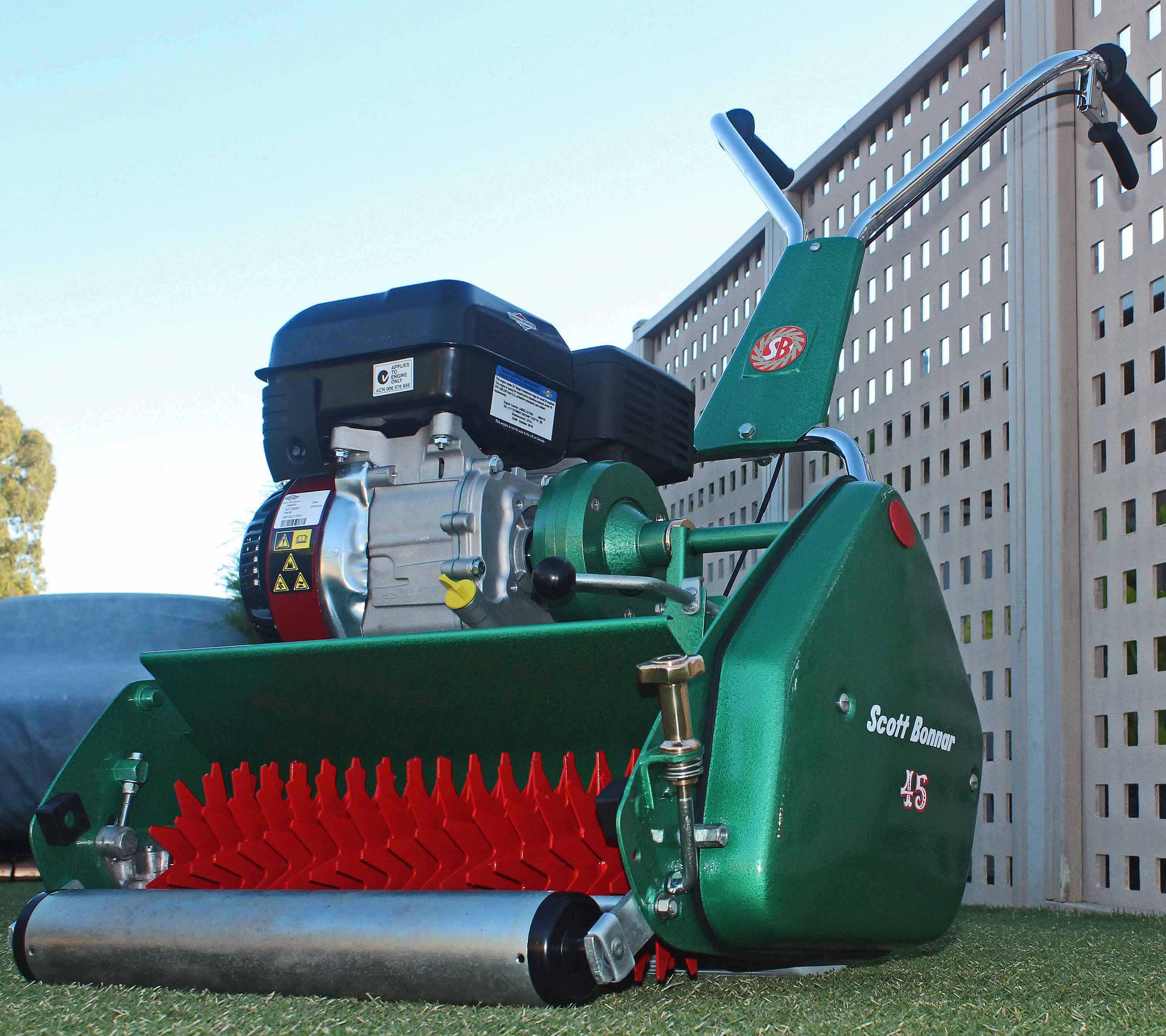
Just thought I would show progress of my rebuild of an early 70s model Scotty.
When I bought it, the clutch would not work and when I tried to adjust it, it just slid along the shaft. I pulled it apart and the cotter pin looks cactus along with the woodruff key. The engine shaft looks a little damaged at the tip, I will let the experts decide though.
Here are a few pics.
Cheers
|
|
|
|
|
Joined: Apr 2009
Posts: 26
Novice
|
Last edited by boeing; 14/06/15 12:55 AM.
|
|
|
|
|
Joined: Apr 2009
Posts: 26
Novice
|
The thrust bearing is also buggered I think, as it sounds quite rattly.
Thoughts on the clutch housing and engine shaft?
|
|
|
|
|
Joined: Aug 2011
Posts: 2,998 Likes: 16
Former Moderator
|
Hi Boeing,
Well I can say categorically that the cotter is shagged and also that PTO shaft is rather suspect.
Can you confirm if that's a definite crack adjacent to the key way ? if it is I would say it's curtains for that crankshaft and replacing the whole engine would probably be the easiest option, depending on your mechanical ability I guess.
The clutch body will most definitely be flogged out and require replacing especially with it running with a shot captive cotter like it was.
The thrust bearing would probably be ok even though it sounds rattly I would clean it out in clean petrol and dry it out then soak it in oil and allow it to thoroughly drain and after that you'll find it should be ok for another battle.
Remember that the bearing will run smooth when the centre race is pushed in and rotated and not the opposite direction as many people evaluate.
I'd like to see some really good close up photos around the engine mounting points on the two rails.
For now,
Cheers,
BB
I live a 24 Hour lifestyle, but every now and again I seem to fall asleep, well at least that's what my wife tells me.
|
|
|
|
|
Joined: Apr 2009
Posts: 26
Novice
|
Thanks BB, there is no crack on the PTO shaft, that was just a grease mark. The key way has some slight marking on one side and the woodruff key is most certainly U/S. The frame rails also seem good. They have been repaint at some stage. When I put the clutch body back on the shaft with the key there is no movement but without the key there is very slight movement. How much movement is too much?
I'll grab some more photos.
Boeing
|
|
|
|
|
Joined: Apr 2009
Posts: 26
Novice
|
|
|
|
|
|
|
Joined: Jan 2009
Posts: 6,926 Likes: 10
Pushrod Honda preferrer
|
That is very clearly a major weld repair to the PTO. It may not break again, but it may not run true due to heat distortion. If you are doing a repair, you might as well run it and see how it goes, but if this is a restoration, the crankshaft is below standard in my opinion.
From your pictures of the rails, I'm not convinced that they are not cracked, welded, or both. You need pictures from above, front, back, and underneath, and from a lot closer up. Remember, that mower trashed its crankshaft, keyway, key and engine side clutch half from running out of balance. If the rails survived that, it would be remarkable. That is a pretty badly damaged mower.
|
|
|
|
|
Joined: Aug 2011
Posts: 2,998 Likes: 16
Former Moderator
|
Hi Grumpy and Boeing,
Well I'd consider that engine as scrap. The crank looks as if it's been silver soldered to hold the broken piece in place while the clutch is placed over the shaft.
I totally agree with Grumpy regarding the the damage that such a situation would inflict upon the chassis rails. I'm pretty sure I can see signs of fractures in the rear rail, but it would be best to using some very coarse sand paper and remove the paint to reveal any damage that's lurking underneath.
I must admit that I picked up a 20 inch machine yesterday that has had both rails totally fail and this will be my first donor chassis to try out the gusset repair method and get it all back together again.
Cheers,
BB
I live a 24 Hour lifestyle, but every now and again I seem to fall asleep, well at least that's what my wife tells me.
|
|
|
|
|
Joined: Apr 2009
Posts: 26
Novice
|
I gave it a sand, and there are a few small fractures on the rails. This would have been the second engine this mower has seen so maybe it wasn't on that long after the failure.
Will post some photos soon...
|
|
|
|
|
Joined: Apr 2009
Posts: 26
Novice
|
|
|
|
|
|
|
Joined: Apr 2009
Posts: 26
Novice
|
Is the best way to fix this by grooving and gig welding?
|
|
|
|
|
Joined: Jan 2009
Posts: 6,926 Likes: 10
Pushrod Honda preferrer
|
We need to see the rails from underneath, and front and back, to see what is going on. There is a vertical line on the vertical flange in the lower picture which looks rather like it has been cut and joined.
|
|
|
|
|
Joined: Aug 2011
Posts: 2,998 Likes: 16
Former Moderator
|
Hi Grumpy,
I'm not sure I'm seeing what you are ? all I can see is the split in the drive roller and nothing on the rear rail flange at all.
As Pauline said, please explain LOL !
I feel that this is the perfect example where the gusset repair method would be the best and then groove out the existing fractures and zap them up with a TIG. Again this really is a job for a qualified tradesman and not a back yard operator.
Cheers,
BB
I live a 24 Hour lifestyle, but every now and again I seem to fall asleep, well at least that's what my wife tells me.
|
|
|
|
|
Joined: Jan 2009
Posts: 6,926 Likes: 10
Pushrod Honda preferrer
|
Quite right, BB I was far too casual in my inspection. It was the separation of the drive roller halves I was looking at.
From the appearance of the area around the cracks, I suspect there has been a repair to the underside of the rail. I'd like to see what has been done there before discussing the next step.
|
|
|
|
|
Joined: Apr 2009
Posts: 26
Novice
|
Roger, I will get some photos from back and underneath. Do you think these surface cracks are severe? Going by some of the ones I have seen on here they don't look that bad.
|
|
|
|
|
Joined: Aug 2011
Posts: 2,998 Likes: 16
Former Moderator
|
Hi Boeing, I will categorically say that those fractures are all the way through from top to bottom. It is at the lower end of the scale compared to what I've seen. I currently have a 20 inch machine that has two totally failed rails and that's going to take a bit of effort to restore back to, one, a fully working and aligned correctly machine and secondly, cosmetically in perfect shape showing no signs of surgery. Honestly I feel that the photo below (gusset Repair method) is a good representation of a solid remedy, after that has been done then the fractures in the rail itself can be ground out and TIG welded to double the strength. Note how the engine mounting nuts are tied in to the gusset so as to share the load onto both pieces of metal. ![[Linked Image]](https://www.outdoorking-forum.com.au/forum/uploads/usergals/2015/06/full-5156-22412-full_6466_21980_imag1212.jpg) A really good job in my humble opinion. ![[Linked Image]](https://www.outdoorking-forum.com.au/forum/uploads/usergals/2015/06/full-5156-22413-full_6466_21991_20150511_225219_resized.jpg) Cheers, BB
I live a 24 Hour lifestyle, but every now and again I seem to fall asleep, well at least that's what my wife tells me.
|
|
|
|
|
Joined: Apr 2009
Posts: 26
Novice
|
Thanks I agree, thats looks pretty good.
|
|
|
|
|
Joined: Jan 2009
Posts: 6,926 Likes: 10
Pushrod Honda preferrer
|
I'm not so confident, BB. It is nicely done of course, but you've got the reinforcement ending near the middle of the span of the rail. There will be a considerable stress concentration at that point, so with the long rail span on the 20" model, there still seems to be some potential for cracking. Time will tell, though it will probably take years to do so.
FWIW, I'd have preferred to see the reinforcement continue to the mid-point of the clutch mechanism platform.
|
|
|
|
|
Joined: Apr 2009
Posts: 26
Novice
|
|
|
|
|
|
|
Joined: Apr 2009
Posts: 26
Novice
|
That's the back rail. Grumpy do you mean extend the gusset to under the clutch?
|
|
|
|
|
Joined: Jan 2009
Posts: 6,926 Likes: 10
Pushrod Honda preferrer
|
Yes, to the center of the clutch mechanism mounting pad, on both rails. That should eliminate the possibility of fatigue cracking of the rail at the inboard end of the gusset.
|
|
|
|
|
Joined: Aug 2011
Posts: 2,998 Likes: 16
Former Moderator
|
Hi Grumpy and Boeing,
ABSOLUTELY !, I couldn't agree with you more Grumpy, regarding the length as that is what I intend doing on my 20 inch machine. I wasn't going to suggest it publicly but decided not to say anything until I had done it myself.
Basically the theme is very good, but wherever the gusset finishes is always going to be a higher flexing point, thus that's where the load will inevitably be transferred to. In actual fact the load would basically be put upon the weld joints at the side plates.
The only way to avoid a vibrating Briggs and Rattler causing any issues is to build the chassis like a "Supercut" or replace the power plant with a smoother running Honda or Chonda.
Cheers,
BB
I live a 24 Hour lifestyle, but every now and again I seem to fall asleep, well at least that's what my wife tells me.
|
|
|
|
|
Joined: Nov 2013
Posts: 6,938 Likes: 317
Forum Historian
|
Hello all
In any case, full credit to Mr Jones' Gusset Plate method.
He has offered a relatively cheap solution to repairing and extending
the life of a great design, that has given decades of proud service
to thousands of users.
All very interesting.
---------------------------------
JACK
|
|
|
|
|
Joined: Apr 2009
Posts: 26
Novice
|
Are the new Briggs engines a lot smoother?
|
|
|
|
|
Joined: Apr 2009
Posts: 26
Novice
|
Are the new Briggs engines a lot smoother?
|
|
|
|
|
Joined: Aug 2011
Posts: 2,998 Likes: 16
Former Moderator
|
Hi Boeing,
They certainly are and also are somewhat cheaper than what they used to be years ago due to the Asian competition.
Cheers,
BB
I live a 24 Hour lifestyle, but every now and again I seem to fall asleep, well at least that's what my wife tells me.
|
|
|
|
|
Joined: May 2015
Posts: 87 Likes: 1
Trainee
|
BB,
Think of the rails as a suspension spring in a car, be it a leaf or coil, if you stiffen up that spring, the axle loads transfer to the spring mounts, what will happen to the mounts?
Changing the flexible nature of the rails will only move your problem elsewhere. I would imagine repairing a side plate with a large crack or hole in it would be very costly and difficult.
Boeing,
Comparing the 1970 B&S with the 2015 B&S they both still wobble around. Getting the right engine speed is the key.
|
|
|
|
|
Joined: Nov 2013
Posts: 6,938 Likes: 317
Forum Historian
|
Hello all contributors,
BB, exactly what model 2015 B&S are you referring to?
I think a modern B&S slant engine to be pretty similar in smoothness to an equivalent Honda.
Both are 'sloper' designs now. Both are OHV.
It would be great to get input from an engine engineer as to how forces are transferred
in slant versus upright piston travel engines... and how that relates to smoothness.
A Historical Perspective
It's pretty clear that when Honda introduced their small engines that they were superior
to the kool bore Briggs used on 45s. In fairness to Briggs, the 6, 8 and 9 series designs
were decades old - even before they appeared on Scott Bonnars.
For me, what the Japanese did was wake America from its slumber, in a way very similar
to its automotive experience. Britain, for example, did not respond anywhere near enough,
and their famous cars, bikes and engine manufacturers disappeared one by one.
America did respond. The Briggs engines of today are a result of consumer trends and
demands post the Japanese experience - and shock. I'm keen to dispel myth here.
If a customer wants a low-spec. Briggs, they can but one; if they want a high-spec.
Briggs they can buy that too! Honda has not ventured into the bottom end of the
market; The Chondas do that, and they do it well.
Anecdote
One thing I am keen to dispel are the general statements: Honda: good; Briggs: bad.
It used to annoy me when I knew so much of Briggs' poor reputation post Honda
was beyond their control. OEMs were regularly misapplying models not intended
for the purpose, in order to gain sales as the 'cheaper product'.
At the Briggs Engine Application Centre I personally saw Australian manufactured
lawnmowers (including ride-ons) that were shipped over for specific application
matching. In many cases, it would be the simple (and complex) changing of a
governor spring that would make all the difference between a machine that would
fail - or not fail - down the track. In other cases, the recommendations were
extensive - ranging from specific modifications in the machine design to a higher
specification of engine. And, yes, there was comprehensive vibration testing.
I also knew that thousands of small OEMs never took advantage of this free service,
and Briggs would cop the resulting criticism.
The issue of the 45 rail failures is a complex one and I believe its cause is
plural - causes. The SB45 is in a unique position in that, for many, it is not
considered a vintage mower. Many have served continuously over three or four
decades (and beyond), and many owners repair them with the intention that they
will be every-week mowers - not show pieces! Any component failures now should
be considered both understandable and forgivable.
Would I recommend a Honda as a replacement engine on a 45? Absolutely.
Would I recommend a Briggs as a replacement engine on a 45? Absolutely.
All very interesting.
-------------------------------------
JACK
|
|
|
|
|
Joined: Jan 2009
Posts: 6,926 Likes: 10
Pushrod Honda preferrer
|
Jack, I explained in another thread how single cylinder engines are balanced and how vibration is controlled. Essentially, all single cylinder engines since the earliest days are "half balanced" unless they have either a reciprocating balance weight or use counter-rotating shafts. Half balancing consists simply of increasing the weight of the crankshaft counterweight to include half the weight of the piston, gudgeon pin, and small end of the connecting rod. Both Briggs and Honda use reciprocating weights or counterrotating shafts on their large single cylinder engines but not on their small ones. So on the small Honda and Briggs engines the balancing technology is the same: half-balancing. However Briggs may do it less well in some cases, by using the same crankshaft on engines with the same stroke but different bore diameters and therefore different piston and connecting rod weights, which would make the half-balancing inaccurate. To be fair, though, Briggs is not the only manufacturer to do this: the Honda GXV120 and GXV140 share the same crankshaft, despite having different bore diameters, and therefore most likely, different piston weights, though I haven't weighed them to verify this. They use the same connecting rod, so that is not a source of balancing error.
I am not aware of tilting the cylinder on a single cylinder engine having any effect on engine vibration: I believe it is done to make the engine more compact, not to make it smoother.
One of the things that gives OHV Honda and chonda engines an advantage over side valve Briggs engines, is that they fire every shot: no misfires. Misfires cause a slight torsional vibration of the engine, and also require the throttle to be opened slightly more to compensate for the missed power strokes. However the main advantage the OHV engines have is that they have a much higher compression ratio - typically 8:1 instead of 6:1 - and so have much less cubic capacity for the same power output. The residual vibration produced by a half-balanced engine is proportional to the weight of the piston, gudgeon pin and the small end of the connecting rod, so OHV engines vibrate less than side valve engines simply because a smaller engine is doing the same job.
The outcome of all this is that provided you select an engine of the same power output, an OHV engine will vibrate noticeably less than a side valve engine. Unless they go overboard with commonising crankshafts across their model range, Briggs OHV engines should potentially be as smooth-running as OHV Hondas of the same capacity.
|
|
|
|
|
Joined: Nov 2013
Posts: 6,938 Likes: 317
Forum Historian
|
Hello Grumpy
Thanks, as always, for that succinct re-explanation. I'm sure it
never hurts to reinforce the basic physics of single cyl IC engines.
You will appreciate, then, my argument that 'apples should be compared with apples'
The old Briggs side valve alloy designs, dating back to the 1950s, should not be
used, or applied to, the modern generation of Honda and Briggs engines.
Your last paragraph - in particular - is a salutary reminder to all, and its principle
is clearly applicable to other long-standing 'which is better?' debates. It's best
to avoid general statements; better to compare model for model - apple with apple.
Cheers and thanks.
-----------------------------
JACK
|
|
|
|
Forums144
Topics12,727
Posts106,660
Members17,960
| |
Most Online40,124
Apr 13th, 2026
|
|
|
|


![[Linked Image]](https://www.outdoorking-forum.com.au/forum/uploads/usergals/2015/06/full-2921-22305-wp_20150613_12_27_30_pro.png)
![[Linked Image]](https://www.outdoorking-forum.com.au/forum/uploads/usergals/2015/06/full-2921-22306-wp_20150613_12_28_08_pro.jpg)
![[Linked Image]](https://www.outdoorking-forum.com.au/forum/uploads/usergals/2015/06/full-2921-22307-wp_20150613_12_42_40_pro.jpg)
![[Linked Image]](https://www.outdoorking-forum.com.au/forum/uploads/usergals/2015/06/full-2921-22308-wp_20150613_12_38_40_pro.jpg)
![[Linked Image]](https://www.outdoorking-forum.com.au/forum/uploads/usergals/2015/06/full-2921-22319-wp_20150614_10_45_57_pro.jpg)
![[Linked Image]](https://www.outdoorking-forum.com.au/forum/uploads/usergals/2015/06/full-2921-22320-wp_20150614_10_47_13_pro.jpg)
![[Linked Image]](https://www.outdoorking-forum.com.au/forum/uploads/usergals/2015/06/full-2921-22321-wp_20150614_10_54_13_pro.jpg)

![[Linked Image]](https://www.outdoorking-forum.com.au/forum/uploads/usergals/2015/06/full-2921-22359-wp_20150615_07_57_57_pro.jpg)
![[Linked Image]](https://www.outdoorking-forum.com.au/forum/uploads/usergals/2015/06/full-2921-22360-wp_20150615_07_58_12_pro.jpg)
![[Linked Image]](https://www.outdoorking-forum.com.au/forum/uploads/usergals/2015/06/full-2921-22416-wp_20150616_18_15_31_pro.jpg)