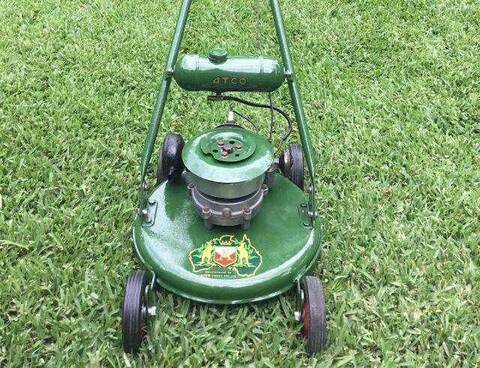
Before I start up my ancient Pope 320 rotary valve engine, I just wanted to double check the correct fuel mix.
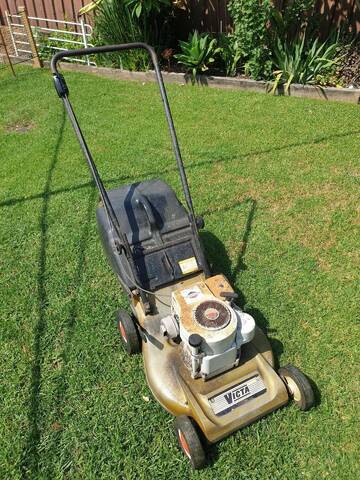
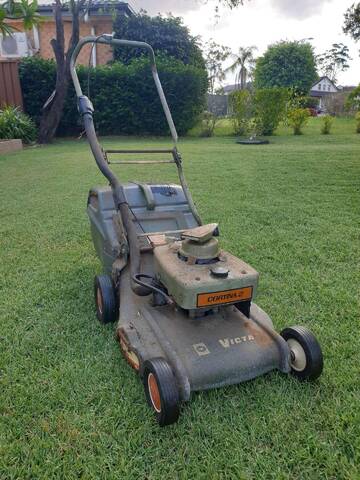
In my Victa Mayfair I use about 120ml semi-synthetic to 5 litres. The manual says 200 ml to 5 litres, but I'm guessing that would be the old mineral oil not modern semi-synthetic?
But the manual for the Pope 320 engine says 1/2 pint to 1 gallon, which translates as 284.131ml to 4.54 Litres. That is nearly twice as much as what I've been using in the Victa!
I am sure they were talking about mineral oil in those days, so maybe with semi-synthetic you would not need that amount?
Can anyone please clarify the correct mixture for both Victa Mayfair and Pope 320. I'll be using the ByNorm 2 stroke oil, which I gather is semi-synthetic?
Speedy, The Pope manual for that model states 62.5 to 1. See my screenshot from the manual posted above. Bit of contention on Google about how many ml there are to a pint exactly, so around about 61 to 1.
16:1 seems a bit light on the oil to me.
Think I will go with Tyler's suggestion of 40 to 1 using a modern semi-synthetic (ByNorm) and see how she goes.
The problem is if the standard specs are 16 to 1 and you run 25 to 1 the fuel mix will be overly rich as the carby is set for 16 to 1.
I ran 25 to 1 on my Pope but it sounded like it's over fuelling down low ,I was going to try 20 to 1 next time with good 2 stroke oil but not with fully synthetic oil.
Hi Vm ,Tyler and Speedy The problem is if the standard specs are 16 to 1 and you run 25 to 1 the fuel mix will be overly rich as the carby is set for 16 to 1.
Morning all, Why all the confusion about ratios. The Pope ratio is 16 to 1... Max, how can 25 to 1 make it it overly rich when 25 to 1 is a leaner mix?
Anyway VM, I don't run my Pope a lot so don't to mix up 4 or 5 lts. but just mix up 500mls. Just use calculator to find the correct amount of oil. Bottom line VM, if the engine hasn't run for years, I'd put some oil down plug and turn engine over a bit to get oil all over rings and maybe some on bearings. There's a front crankcase plug, you could put some oil in. It will smoke for a bit, run gently . Good luck with first start.... get pics. speedy
........................Keep your blades sharp......................
The confusion was my fault Speedy. I was just wanting to know how many mls to add to a litre and using ":" as shorthand for "to". I realize now that you were talking the other way around, i.e. petrol to oil, 16 parts to 1 part, hence 16:1.
Max can correct me if I'm wrong, but I think he is suggesting 20:1 (fuel to oil ratio), or 1ml of oil to 20 mls fuel, which is a fair bit richer (fuel-wise) than what the manual specifies.
To avoid any further confusion, I'll just go with what Tyler suggested: 40 ml oil to 1 litre fuel, 160 ml oil to 4 litres fuel, or 200 ml oil to 5 litres fuel.
25 to 1 is a richer fuel to air ratio compared to 16 to 1.
16 to 1 is recommended when a car engine oil was used as 2 stroke oil so the carby jets etc are tuned for this ratio ,I don't think 20 to 1 with good 2 stroke oil will harm anything.
Seems a lot of oil to me, but that is what the manual specifies, doesn't it? I am sort of expecting a lot of smoke. I will ask the former owner of the motor. Pretty sure he was running it on half that and the motor is still alive today. It really copped a work out from him for many decades and never missed a beat the whole time.
It is interesting that on the ByNorm 2 stroke container, they specify a whopping 50:1 ratio as a "general" mix, which is only 25 ml oil to a litre of petrol. I am guessing that must be for the small, highly aspirated modern engines like whipper snippers? But now that I think about it, I am sure that is all my dad ever used in his Mayfair and the engine is still going strong today. So I really wonder if it matters all that much. I recall my father would often just take a guess when mixing and never had any problems with his 2 strokes. I never saw him measuring things accurately to the ml. Often he just had a small tin which was "around about right" and he would fill it up and tip it into the jerry can. If he got smoke he knew to add less next time, if the mixture seemed too rich he would tip in a bit more oil. Funny thing, when I was running the Mayfair on the ByNorm specifications it was blowing out a bit of smoke and an older relative told me I was putting too much oil in the mixture! So I'm not sure and totally confused now. Will do what the manual suggests and if too much smoke will cut back.
My feeling is that with a semi-synthetic oil of today you would not require as much as what the manual suggests, because it was written back in the day of old mineral oils. So as Tyler pointed out, I think 40mls per litre would be the most practical.
Yes I wasn't saying you can't run 25 to 1 (200 ml to 5 Lt) Vm ,it's just that I did that last time with my Pope and at 48 seconds in on the video on decelerating I can hear the motor over fuelling and popping noises from the muffler so you can put more oil into the fuel mix to fix this or tune the carby to suit the 25 to 1 mix..
The problem with veering away from the recommended fuel/oil ratio is the carburetor is set up for the right amount of petrol/oil/air mixture, so if you significantly alter this ratio you will need to change the jets and carby settings to suit.
A typical example: you go from a 50:1 ratio to a 20:1 ratio. Your engine will now run leaner, and you’ll have to make jetting changes. You’ll need bigger (in number) jets because the oil molecules are thicker and the flow rate (the amount coming through the jet) is less. Aha! The volume of fuel has changed. The oil takes up some volume that the gas used to occupy, so your engine is getting less gas and needs to be richened up.
With the Pope it's the opposite going from 16 to 1 and then to 25 to 1 ,the jets need to be smaller.
STIHL recommends the following.
The recommended fuel-oil mix ratio for most small 2-cycle (2-stroke) engines in handheld tools is 50:1 when using synthetic 2-cycle oil.
You can use the 50:1 ratio with any synthetic, semi-synthetic or additive oil and all two-stroke handheld power tools unless the manufacturer specifically recommends otherwise.
There are some exceptions to this rule:
If you are using old mineral two-stroke oil without any additives, you may prefer thicker mix ratios of 25:1 or 33:1 to ensure adequate lubrication. Husqvarna recommends 33:1 for 75cc and bigger engines in high-load applications
IT'S ABOUT THE OIL
The 50:1 mix ratio is thinner, i.e. has less oil, than those used in the past. Older tools had thicker recommended mix ratios of 40:1, 33:1, 25:1 or even 16:1.
, the reason for the shift from 33:1 or 25:1 to the thin 50:1 mix seems to be that newer engine oils lubricate better than old. New engine oils are synthetic, semi-synthetic or have additives that improve their performance so that less oil is needed for the same lubrication effect.
The more oil in gas, the better the lubrication. As oil has some downsides, the amount of oil is usually set to provide adequate lubrication. The oil content required for adequate lubrication depends on the oil type and additives, but with synthetic oils 50:1 should be enough.
While oil is necessary, it does promote engine fouling. Most engine oils burn only partially and not very clean in the engine, leaving a residue on the engine parts. This residue or deposits can cause engine issues.
The incomplete and poor burning of engine oil increases the smoke in the engine exhaust. This smoke consists of small soot particles and constitutes particulate emissions.
The more oil in the gas, the higher the emissions. As with fouling, the cleanest results call for as little oil as possible. The amount of smoking depends also on oil composition and engine operation point.
MIX RATIO IS A COMPROMISE
As you see, the choice of gasoline–oil mix ratio is a compromise between lubrication and clean combustion: there should be enough oil to prevent engine seizing and premature wear, but no more to keep the fouling and emissions down.
Note that the consequence of too little oil and inadequate lubrication (engine failure) is much worse than too much oil. Using a thick, oil-rich mix ratio like 25:1 or 33:1 is playing it safe, and was necessary with older oils and engines.
However, most modern oils and engines will be adequately lubricated with today’s oils at 50:1 ratio.
I would think on a mower like the pope over fuelling the engine would make the motor run hotter
Just wanted to explain how if you change the fuel ratio from standard it can effect your engine to run leaner or richer.
Thanks Max, I appreciate the explanation and the details
I had an interesting conversation with my uncle who was the former owner of the Pope engine. Now get this! He says he only ever ran it on 25ml of 2-stroke oil to the litre, and he first bought the mower in 1964. When the mower finally fell apart, he kept the engine and converted it to horizontal and used it to to run an air compressor right up until the 1990s. In all that time he only ever gave it 25ml to the litre. He said he ran that in all of his 2 strokes always and never had any problems. I told him what the manual said and he couldn't understand why anyone would want to add that much oil, even in those days. He said "You'd look like an old steam train coming along if you were to use 40ml per litre or more." All I can add is if he was going to kill the engine by using 25ml per litre, it sure has taken its time to die. :-)
That's interesting Vm, 25 ml of oil to 1 Lt is 40 to 1.
I've had a few old Victa motors and the motor has compression and runs but the conrod clangs as the motor runs and either the big end is loose or the Gudgeon bush is loose and that is a sign of too little oil in the fuel mix.
Some of the older engines need more oil in the mix so the low quality bearings get adequately lubricated or they can prematurely wear out.
I have heard of some people running old Villiers 2 strokes at 32 to 1
For me I wouldn't go thinner in oil than 25 to 1 with old motors and would put the needle down slightly in the carby and that is with Valvoline Outboard 2 stroke oil ,the main use of this outboard oil is for water cooled motors but this one is also recommended for other air cooled 2 stroke equipment.
It just depends on the owner what mix they run as I've seen some people use old sump oil as 2 stroke oil, on the other hand I don't think it's worth buying super expensive racing 2 stroke oil as some people do for a lawn mower.
Yes Max, my uncle was telling me that when he was on the farm in the early days there was no such thing as 2 stroke oil, just engine oil. Huge difference to today where we now have a large range of specially formulated synthetic and semi-synthetic oils designed for different applications.
Hmm, not sure about that. At least where I grew up, where the nearest town had 800 people, there was two stroke petrol sold at a pump. It was green, whereas “super” was red.
We’d buy 20 litre drums of two stroke oil from the same wholesaler who sold us engine oil and hydraulic oil as it was much cheaper that way.
He can't remember it until later in his life. He lived way out bush and had very little money so probably had little choice but to use whatever he had, so what went in the car probably also went into the 2 strokes if they were lucky, otherwise they just got the recycled sump oil.
Speedy, this build has been so troublesome and expensive I doubt I will ever take on another complete restoration and renovation. I am still short of a number of parts with little hope of obtaining them any day soon. Pope parts are near impossible to get, so I have borrowed from Tecumseh, Victa, Briggs and Stratton, and even resorted to making some parts. I got on to a few N.O.S. parts but the seller was not very sympathetic and just threw them all into a flimsy box which fell apart during transit. As a result a lot of the parts got bent and badly scratched up and one part went completely missing. Today's paints are also bothersome as my first paint job on the handlebars went wrinkly and cracked overnight for unknown reasons. Yet I put the same paint on the hubcaps that same day and it went on perfectly. But then the fumes from the glue I used to fix the hubcaps in place reacted badly with the paint and overnight caused it to peel. I could not believe it. I'm still looking for a glue that will not react with paint. I later repainted both and had the handlebars hanging up, but for some reason the wire support decided to break, sending the handlebars crashing into the dirt and on to nearby rocks and pavers. So I had to clean it back to bare metal again. Third time lucky, I hope!
I rarely do renovations, least of all hybrid ones, but I wanted to do this for my uncle so he can at least see a version of his beloved old Pope back in near pristine condition. I am not doing it for myself, I am doing it for him. The lawnmower may never be started if truth be told. It all depends on how I feel at the end of it all. As this build has been so troublesome I am in two minds about ever starting it. All it takes is for a drop of fuel to land on the painted surfaces and days of work can disintegrate before your eyes. I've been there before! I may end up just placing it inside as an ornament and conversation piece.
I rarely restore vintage mowers to "as new" condition these days, just to working order. It is just too expensive and finicky and at the end of it all I don't feel like getting them dirty again. Once we use them, moisture gets in and promotes rust all over again. A moron came to paint the shed roof a while back and he obviously had no idea what he was doing, as he hosed upwards instead of downwards, sending an avalanche of water into the shed, and drowned a lot of my restorations in mud. This sent them instantly rusty. I only found out a few days later when I opened the shed and by that time the damage had been done. Spare parts too, all covered in water and muck. They will never be the same.
So, there are some I restore from time to time to near new condition and then keep in storage, others I start, others I just get going and never fully renovate but use around the place. No build ever turns out the same or for the same reasons. I dislike painting immensely and prefer to just tinker and get things going. The Pope was an exception. The few parts I managed to scrape together were all in such terrible condition that I felt they had to be restored.
I'll post up some photos when it is finished, but that may not be for a while. Rome was not built in a day. Persistent cloudy, rainy weather has once again put me well behind schedule.
Today's paints are also bothersome as my first paint job on the handlebars went wrinkly and cracked overnight for unknown reasons. Yet I put the same paint on the hubcaps that same day and it went on perfectly. But then the fumes from the glue I used to fix the hubcaps in place reacted badly with the paint and overnight caused it to peel. I could not believe it. I'm still looking for a glue that will not react with paint. All it takes is for a drop of fuel to land on the painted surfaces and days of work can disintegrate before your eyes. I've been there before!
I don't have the problem of paint washing off with fuel if I use a good quality paint ,VHT or any engine high temp paint won't wash off with fuel.
My Victa ride on mower was done in VHT SP123 ENGINE ENAMEL CHEVY ORANGE .
Using some Silastic is my preferred method for gluing hubcaps on,that way they can be removed again without a problem.
Thanks for the tip Max, but too late for this build. Paint has become very scarce at my local hardware shop since Covid. The choice has reduced down to just a few cans of cheap Fiddly Bits or very expensive Killrust brand spray paints. They once stocked a huge range of paints, but no more. I did find a lonely can of Rustoleum Farm Machinery in orange for the base, but had to settle for Killrust gloss for the white handlebars. I have found it to be the worst paint I have ever worked with. The can suggests a recoat after 16 hours but my advice to anyone is DO NOT do that. I did and it went all wrinkly after an hour or so. Just one coat is fine, but whatever you do, don't add another. I tried silastic once and had the same problem with it reacting with the automotive paint. Lately I've been using super glue, because at least it only requires a couple spots, which is less likely to do damage. Your paint job looks superb by the way! I hate painting as I am allergic to the ingredients and am more likely to make a mess than do a half decent job. That's because I try to get the job done too fast so I can get away from the fumes.
Great VM , you got the base done with Rustolium. Petrol won't melt that. That's what I use on all my restores for that reason.. Give a go and start it, you did so much work. you deserve to see it kicking over.... I could have got more rustolium here in Bundy, but I don't know if you can send them in the mail... it's all good. speedy
........................Keep your blades sharp......................
I tried silastic once and had the same problem with it reacting with the automotive paint. Lately I've been using super glue, because at least it only requires a couple spots, which is less likely to do damage
With Automotive paint ,after painting I would not touch the painted panel etc for at least 1 week to let the paint harden.
Painters say not to wax clear coat until 2-3 months .
The Victa ride on looks OK but probably not worth the effort as not many people are interested in old Victa ride on mowers so has less value than it takes to repair the mower but I guess a lot of the mowers we repair are like that. .
Originally Posted by Mowerfreak
Very nice maximillian! Why aren't more ride ons sporting black rims?
Yes you don't see a lot of ride on mowers with black rims Mf .The Hustler Raptor has black rims.
I find automotive paint without the benefit of dryers, takes an incredibly long time to dry, like months, even years to properly cure. Even after 3 weeks sometimes I have started handling it and next thing you find yourself leaving fingerprints or getting paint on your fingers. A lot depends on the weather too and this horrible cloudy, drizzly, cold weather we are getting lately is definitely not ideal painting weather. I've resorted to doing a few small items inside an enclosure where it is not quite as damp, but still having problems. Will just have to wait until warmer weather. Another reason why I dislike painting so much. It is too finicky.
No wonder there's 2K with a hardener component. A shame it's so hazardous and you need a very expensive set up to use it safely.
I don't recommend using White Knight rattle can paint. I painted up a Victa sign in black and a cloth cover has stuck to it well after it's drying time.
Ahh, if only victa had kept producing the thumblatch catcher series, they would be in better shape today!