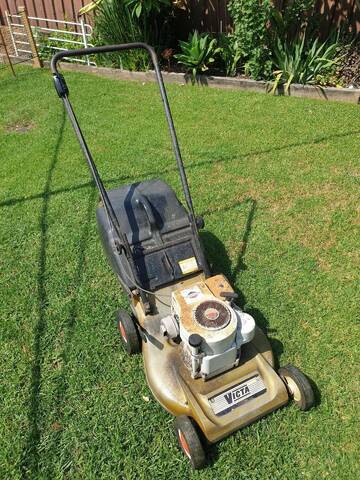
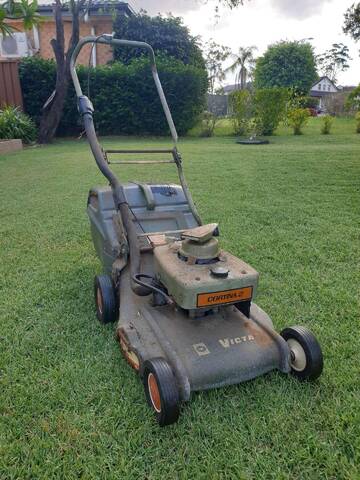
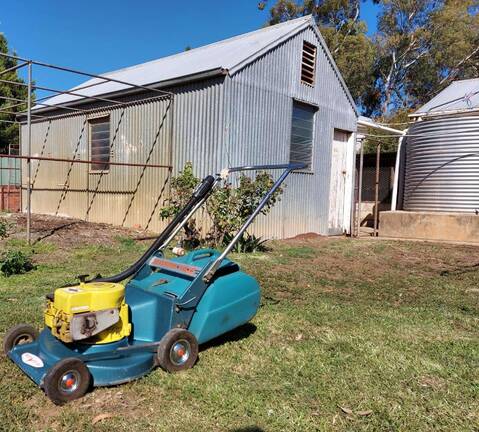
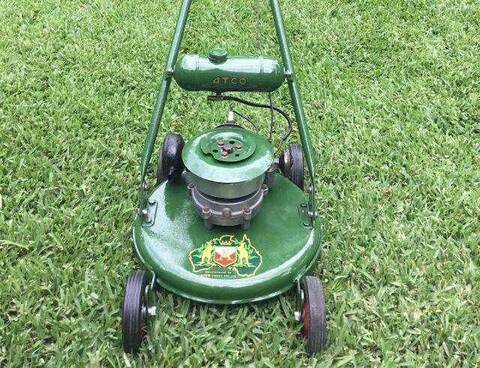
I got this from the recycle centre and thought it was an excellent buy for $25. I noted that the blade holder and boss were missing but didn't see the hole and dent in the sump. The original hole was about a quarter of the one in the photo as I caused more damage when I tried to flatten out the dent. I don't think anything other than TIG welding would last in that oily environment but I have heard of JB weld giving good results but would you trust it? The oil seal is damaged as well and its seat is in need of filing and smoothing out as the hole extends into the oil seal seat.
Is it worth trying some of the epoxy fillers or not? .
Hi speedy, My attempt would be to make up a sheet metal patch to fit over the hole,about 10mm bigger all around, fold it up the side if it needs it. I'm not sure if I would use JB on it as it goes hard, but it might be ok. My preference would be to use something like 518 Loctite gasket maker because I know that works well and can handle gaps and withstand crank case pressure, then put a couple of pop rivets to hold it in place. Make sure you seal over the top of the pop rivets. Problem is the Loctite is expensive but you don't need a pot to get a good seal. As for the seal I would fit it and then JB over the damaged section
Hi AVB, Glad to hear you are still here, very worrying what is going on over in the States. As for getting the case welded up the big problem with that is that it is still just a Briggs and not worth spending much money on it. Would certainly cost more to get it welded than it would ever be worth
How does a hole like that happen? a big rock or something from underneath? I'm assuming its from underneath not inside... Would like to have seen the disk in that case!
Oh, these engines are being thrown away by the dozen these days, just keep an eye out for another one
Hi AVB, Glad to hear you are still here, very worrying what is going on over in the States. As for getting the case welded up the big problem with that is that it is still just a Briggs and not worth spending much money on it. Would certainly cost more to get it welded than it would ever be worth
Been worried about things too. I have cut my weekly trips on Sundays to near zero and only out for groceries once every couple weeks during the work week to avoid the crowds. Prices are trying to go through the roof for meats. No way I going to pay $7 a pound for hamburger (ground beef) when just before thing thing hit it was just under $3 a pound.
Everything seem to have been going well until they started relaxing the rules.
Originally Posted by nath
How does a hole like that happen? a big rock or something from underneath? I'm assuming its from underneath not inside... Would like to have seen the disk in that case!
Oh, these engines are being thrown away by the dozen these days, just keep an eye out for another one
Since I never seem an engine in that area I have no inking what caused it. And these engines are considered throw a ways as it cost more to fix them then replacing the whole mower.
I had one here with a hole some time back. It was caused by siezed piston and broken conrod...... I just took good parts off and the rest went to scrap metal... Does the motor turn over? Silicon is very heat resistant as well. I'd see how far you can go without spending money. speedy
........................Keep your blades sharp......................
Thanks for all the suggestions. I think that mower would cost around $400 when new. It doesn't look that old. But I see a few of them out at the tip and the last one I saw also had a hole in the block. I could get that whole engine for $20 so that might be the way to go. All of these mowers seem to be missing the air filter cover for some reason.
I have a few aluminium soldering rods left over from another job. They didn't work for me back then so I am not confident they'll do the job this time either.
hi sparker, If you didn't get the mower. Here's what I'd do. A piece of aluminium, just grab a sauspan lid you don't use much. Cut a piece, bend it . drill a few 1/8 inch holes and fix it with rivits, with silican as a gasket.... speedy
........................Keep your blades sharp......................
Exactly speedy, bit of colorbond or anything, after all it is only a Briggs. I had a commercial Honda dropped off here to see if I could fix it, apparently it had been taken to one shop and they said it was unfixable because it had broken the case. Second shop did a repair job (best they could do was JB Weld, which was never going to work as it was the left hand mounting point for the pull start/cowl) She was charged $175 for that plus and it looks like they gave it an oil change and new filter. The repair lasted about 15 mins before the cowl let go again. I made up a good solid bracket to mount the cowl, welded up where it was broken at the front and it took me probably a couple of hours to repair a very good Honda that was claimed to be unrepairable. Moral of the story is things can be repaired, without just replacing parts
Ended up filling the hole with plumbers solder then I patched over it with JB weld. I started the engine with a drill and it ran OK on the prime I gave it. I need a blade holder fitted to it to test it out properly. The mower I had my eye on for parts was gone when I went back to look.
If you buy a mig welder don't get one from China unless someone you know gives it a thumbs up. I bought an el-cheapo one on ebay to replace my Italian made mig welder. I have never been able to use it properly. I get wires sticking in the weld, spatter, blobs etc. I had no trouble with my old mig but the handpiece was worn out and the cost of the handpiece replacement was the same as a complete brand new inverter welder from China but it is total rubbish.
Hi Norm, I did think about that. The set up is different because on my old welder the wire would not arc unless the trigger was depressed but on the Chinese one the wire is always active. I just have to touch the wire to job for it to arc. That's another thing I had to get used to. I guess I could bypass the trigger switch but I don't like messing with welders. The old welder was about 12 years old so it gave me good service.
Hi sparker, that seems very strange, I can't understand how it would work, never seen seen anything like it, how do you stop when you have finished the weld, if you are stitch welding something? sounds impossible. I bought my arc welder in 1964 and it has been in constant use ever since. The mig I bought 25 years ago has always been problematic and I haven't used it for several years, don't have the time to sit down and fix it
Hi Ted, It is a Monarc, made in Albury, it has ended up half under water twice, and it sat on the back of my truck for years out in the open. Not sure how many amps it runs, I have always run it full amps with 12 gauge rods and half with 14 gauge. Cost me 52 pounds when I bought it which was a few weeks wages at the time. Once I carried it up 3 flights of stairs, these days I can pick it up but I can't walk with it
Wow, made in Albury, there you go. Pretty interesting. Must have had a good case to work after being in the rain. Very interesting, I bet it makes a fair old hum when it runs
Hi NormK, if you bought it in 1964 what brand is it, Peerless or something ? If its a arc welder how many amps does it go to ?
Most of the AC transformer welders in those days were rated at ~130-140A max current, @50V open circuit.
I have a 1970s vintage Melbourne built copper-wound Powamac Minor, that's rated at 130A output, 15A 240V input, 100% duty cycle. 'Punches above its weight' a bit, as it'll quite happily run a 4.0mm rod, on its max setting.
I have used inverter welders in the past, of the ESAB Caddy type - good jiggers. And this cheapie is shaping quite well.
I'm not really interested in a MIG welder, as it wouldn't be well suited to the type of small jobs I do. And for sheetmetal stuff, I have Oxy/LPG torch brazing/silver soldering.
Cheers, Gadge
"ODK Mods can explain it to you, but they can't understand it for you..."
"Crazy can be medicated, ignorance can be educated - but there is no cure for stupid..."
Hi Gadge My mate bought an ESAB one about 30 years ago, ( about $1600 from memory) and we were using it on site welding up 1.6mm handrail stuff, was an amazing machine, and was nice and light so you could carry it up a ladder if you were working up high. Never asked him what happened with it because there is another little 240 welder I use often when I am up there repairing/building something. Around the same time he bought 2 ESAB shields and they were $500 each. I still use my flipfront as I have done for years, but in the factorys over the years we used self darkening because they were faster. Always gets a laugh when I go to the factory with my flipfront, the apprentices can't believe I still use one
Not for everyone though. A mate was using a mig and was doing a bead weld on 2 different thickness bits of metal together. He was having issues getting feed speed and volt right and was doing a test weld - 2cm, stop, lift front check put back down do a bit more
He got annoyed and started going quicker, got a bit arm tied and half lifted the visor and hit the trigger, sparks bounced straight up
Lucky he had safety glasses on as well, but still bloodshot and 'sunburnt'
Then worked out the eye wash station had a 3-6 month drowned rat it in, but thats another story
I found the Bunnings electrodes not good, like those sparklers I had as a child.
I found the cigweld weldskill 6013 rods pretty good and I bought from Total Tools. I've used both 2mm and 2.5mm and I wouldn't say I can weld well but I can run a bead and join together two bits of metal. It's a little hard to strike the arc but I've found having a good ground with the clamp is important (using a C clamp close on to the metal close to the welding point) is important and having the amps turned up a bit higher than they recommend. I tried mitring together some square tube with 1.5mm wall but I found even with 2mm electrode easy to blow a hole through. That said I reckon the joins that this welder creates are pretty decent & very strong.
I'm going to try and make a basic stool out of concrete rebar as a first proper project.
Norm, The mig starts welding as soon as the wire has connection to the earthed article to be welded. As soon as you break the arc it stops welding. It is not dependent on the trigger. As long as there is wire exposed from the handpiece and it touches the earth it starts the arc. That's different to the old one where the trigger would first start feeding the wire and then a further depression of the trigger would start the arc.