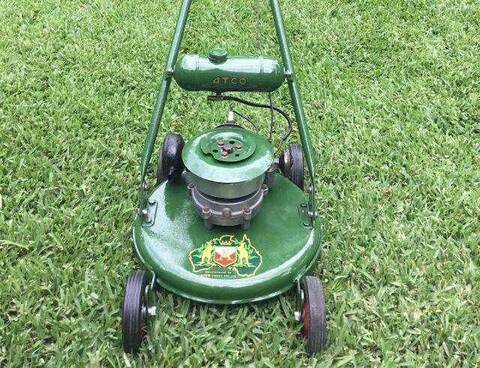
PART THREE - Standard Model for 1955-1956The
Standard had a 16 inch cutting width, and the Standard chassis would
form the basis for the
Model 70 and
Vampire models (with modification).
Here I would like to clarify the known specification for the first model.
It was both
advanced and primitive. It had the advanced patents (as
discussed) and I have no doubt the height adjuster was the key feature ...
more advanced than the guess work for height control on many competitive
lawnmowers. However, the height adjuster lacked - at this time - the rear
turn-wheel: meaning that 'pinch-bolts' needed to be loosened to adjust
height of cut. The greater defect in the Villager system was that it
lacked memory pre-sets (to reproduce desired heights).
It appears to have had
solid alloy metal wheels (without rubber
vulcanisation or separate tyres). That is amazing; given that Victa had
rubber tyres from 1953! There is evidence that Villager corrected this
for the next season ... using steel hubs with rubber tyres.
The first Standard had the limitations of a
fixed handle. This limitation
should not be under-estimated in the history of the rotary lawnmower.
The increasing ownership of motor vehicles meant that transporting rotary
mowers was problematic. Within a season all that would change - with
folding handles becoming popular.
On the aesthetic side, the Villager was a
handsome lawnmower, with its
distinctive
football shaped fuel tank (made from copper). That Villager
offered customers a small range of
colour choices is amazing ...red, green,
or yellow - said a 1956 advertisement [Part One, above].
A final point should be made about one feature -
'Simple Flick Starting'.
What was that!? The answer came in an early 1957 feature article in
Villiers Magazine:-
![[Linked Image]](https://www.outdoorking-forum.com.au/forum/uploads/usergals/2016/11/full-7392-31224-1957_oct_villager_mowers_flick.jpg) TO BE CONTINUED ...
TO BE CONTINUED ...