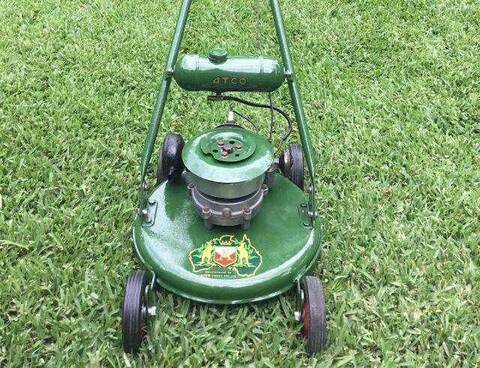
Carburetor on crankcase is common on some types of engine, but it is only feasible with reed valve or something that achieves the same effect of only permitting gas movement into the crankcase, not out of it. It isn't the use of a reed valve, though I haven't heard of one as early as 1936, that I was commenting on - it is the layout of the carburetor. It looks as if it is a suction carburetor like a Briggs Vacu-Jet, which uses venturi vacuum to draw fuel up from the tank. It probably has a slide system directly above the fuel entry point, with a fixed spring pushing the piston down the slide: if so it is a constant vacuum carburetor like the traditional SU or the later Stromberg CD. The vertical column to the right of the venturi system probably acts as a choke, but that doesn't tell us how the engine is speed- or load-controlled. You can't throttle an engine from upstream of the venturi since that would vary the air/fuel ratio.