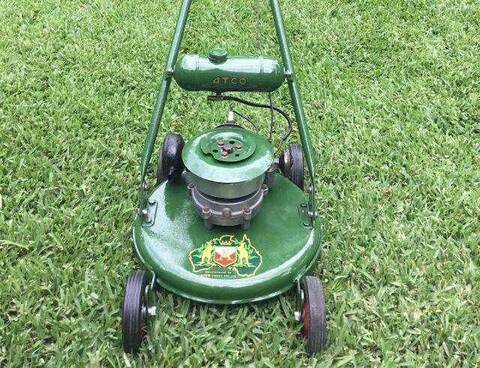
Mate, info on these early Pope's is thin on the ground, I have tried to do some research this morning for you, but to no avail. I would hazard a guess that they would be from the 60's, but as to model or colour scheme...I haven't a clue.
Please do not PM me asking for support. Please post your questions in the appropriate forums, as the replies it may receive may help all members, not just the individual member. Kindest Regards, Darryl
I had a similar model Pope running a villiers mk 3 it was a 60 model from memory,but had a pressed steel base very similar to this and possibly earler than the one in ty's thread.. So Id say by styling its a late 50s model as Grumpy says. I saw a thread a while back by Memeber "Joe Brown identifying one in the thread as definately being POPE. ....Maybee he might be able to shed some light on the model details?.
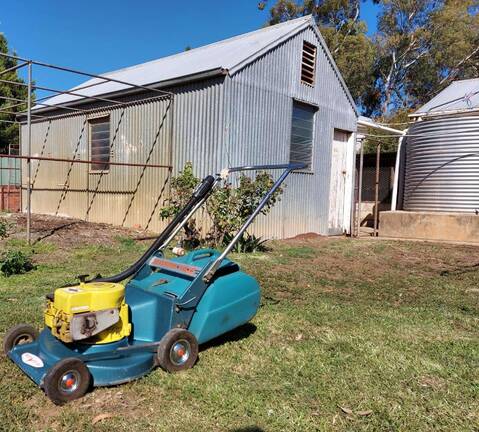
Yep, you've got a pair of rotary valve Popes, in what looks like very close to original condition. It would be useful to document them - these are the first to ever turn up on Outdoorking, I think.
The first really complete ones, anyway. There have been a few posts of incomplete and 'bodged' ones in the past here, but that's all. Pope also made push reel mowers, and their first power mower was a motorised [petrol or electric] version of that. These I'd say, were the second generation. By 1965, Pope had gone to wind-up starters.
These were around 1958-early 1960's vintage. My old man bought one around 1966, and it was secondhand even then. I still remember that beast; it could be a bit of a bear to start, but was quite grunty.
Dug out my other Pope mower and the carburetor is on the other side still goes to the crank housing Look at what the original painted on the fuel tank Ian
Hey Ian, the original owner was not bad at sign writing was he! Nice machine in great condition for its age...BTW...were the white hubcaps original on this model?
Please do not PM me asking for support. Please post your questions in the appropriate forums, as the replies it may receive may help all members, not just the individual member. Kindest Regards, Darryl
His sign writing is cool, but his Math? That mix would make approx 14:1....Very well lubricated, No engine wear in this model as he probably couldnt start it lols.
16:1 actually, but that was what the factory recommended.
This was in the 1960's, before the specifically formulated two-stroke oils became widely available.
Even then, most of the first ones on the market were intended for water-cooled outboard motors, not air-cooled engines!
That only changed when high-performance 2-stroke motorcycles started coming out of Japan in the mid 60's, and not immediately even then. Even in the 70's, Castrol Super Outboard was the specified oil for Echo engines.
Cheers, Gadge
"ODK Mods can explain it to you, but they can't understand it for you..."
"Crazy can be medicated, ignorance can be educated - but there is no cure for stupid..."
Seriously? Why does Victa, villiers and just about every other 50s mower run between 25 and 32:1. They were also using the same oils. Never heard of a 2 stroke ratio so low. Actually my fuel book says Pope is 1/4 pint PG. Must have just been the early Pope engine?
You'd have to ask the factory engineers of the time that one! Keep in mind also, that there were these early rotary valve Australian engined Popes, and a later 1970's on 2-stroke series that used a Japanese Fuji Robin engine. Totally different beasts.
The early Victa mix was actually 24:1 [1/3 pint Castrol XL to 1 gallon of Standard grade petrol], and quite a few 1950's Villiers [e.g. the Midget series] ran 16:1.
As did many of the earlier chain saws, up to the Mono [US] sourced Mobilco saws that were still [though only just] on the market in the early 1970's. Primitive beasts, those things!
Cheers, Gadge
"ODK Mods can explain it to you, but they can't understand it for you..."
"Crazy can be medicated, ignorance can be educated - but there is no cure for stupid..."
I was just passing through. The link to the Historical Record for the Model 320 does show the recommended mix as being 1/2 pint to 1 Gal.
Blue asks an interesting question, and Gadge's reply is probably correct - ask an engineer of the time. But ...
There may have been inconsistent quality control in earlier times, with fuel in particular. I have seen records expressing concern about some consumers not understanding more complex ratios, and also the difference in the 4-cycle engines folks had become accustomed to, and the two strokes.
A second reason may be about quality control within the engine itself. So, I speculate that the ratio was a fall-back simple ratio to be safe, rather than sorry, and probably grounded in the history of quality control for oil, fuel and engine production.
In reference to the Midgets, this was the ratio for early two-strokes, but I note that in my Villiers Midget book they recommend 20:1 once the engine was run in:- [Note the concerns about oil brands and adequate mixing]
CyberJack, I defer to your comprehensive knowledge of the Villiers Midget engines.
My reference for that fuel/oil mix was the Owners Manual for the Midget engined Ransomes Minor Mk6, which came up in a past ODK thread we both posted to. Which just said to use 16:1 ratio. That was with SAE50 viscosity oil, too..
Cheers, Gadge
"ODK Mods can explain it to you, but they can't understand it for you..."
"Crazy can be medicated, ignorance can be educated - but there is no cure for stupid..."
Yes, That makes sense. I didnt take into consideration the oil of the day.
I run all my Rotomos at 25:1 and My midgets at 32:1. I cant even run a Villiers 3/5 G at 25:1 as it spits oil.
So This is why I never noticed original fuel mixes for some mowers being as low as 16:1. My book also says the same for Midget....But the manufacturer specs for Villager running a 5 g is 32:1...Only 28cc different. Go figure.
A testament to todays oils I guess. And im thinking manufacturers original Ratios no longer apply.
A testament to todays oils I guess. And im thinking manufacturers original Ratios no longer apply.
Very true, that. Few people outside of the lubricant/tribology [lubrication engineering] field realise just how great the advances in these technologies have been, in the period 1950's to the present day.
Changing the fuel mix ratios can be a bit tricky though; as the changes in density, viscosity and surface tension of the fuel/oil mix will also have a significant effect on the fuel/air mixture ratio that a carburettor achieves. All else being equal, lowering the oil content will tend to richen the mixture.
Cheers, Gadge
"ODK Mods can explain it to you, but they can't understand it for you..."
"Crazy can be medicated, ignorance can be educated - but there is no cure for stupid..."
Gadge, I understand the smiley emoticon after 'comprehensive knowledge'
Yes Mal,
I think oil and fuel and the ability of them both to stay in suspension, as a mix, was of concern 'in the day'. Note that Villiers in their instructions only recommended one brand ... "Oils ain't oils".


![[Linked Image]](https://www.outdoorking-forum.com.au/forum/uploads/usergals/2014/04/full-7423-16022-pope_1.jpg)
![[Linked Image]](https://www.outdoorking-forum.com.au/forum/uploads/usergals/2014/04/full-7423-16023-pope_2.jpg)
![[Linked Image]](https://www.outdoorking-forum.com.au/forum/uploads/usergals/2014/04/full-7423-16024-pope_3.jpg)


![[Linked Image]](https://www.outdoorking-forum.com.au/forum/uploads/usergals/2014/04/full-7423-16050-img_3065.jpg)
![[Linked Image]](https://www.outdoorking-forum.com.au/forum/uploads/usergals/2014/04/full-7423-16051-img_3066.jpg)
![[Linked Image]](https://www.outdoorking-forum.com.au/forum/uploads/usergals/2014/04/full-7423-16052-img_3067.jpg)

![[Linked Image]](https://www.outdoorking-forum.com.au/forum/uploads/usergals/2014/04/full-5599-16250-poperotary01.jpg)
![[Linked Image]](https://www.outdoorking-forum.com.au/forum/uploads/usergals/2014/06/full-7423-16700-img_3225.jpg)
![[Linked Image]](https://www.outdoorking-forum.com.au/forum/uploads/usergals/2014/06/full-7423-16701-img_3226.jpg)
![[Linked Image]](https://www.outdoorking-forum.com.au/forum/uploads/usergals/2014/06/full-7423-16702-img_3227.jpg)


![[Linked Image]](https://www.outdoorking-forum.com.au/forum/uploads/usergals/2015/02/full-7392-20572-history_record.jpg)
![[Linked Image]](https://www.outdoorking-forum.com.au/forum/uploads/usergals/2015/02/full-7392-20574-scan_12.jpg)
![[Linked Image]](https://www.outdoorking-forum.com.au/forum/uploads/usergals/2015/10/full-7392-24440-history_record.jpg)
![[Linked Image]](https://www.outdoorking-forum.com.au/forum/uploads/usergals/2015/10/full-7392-24441-locked.jpg)