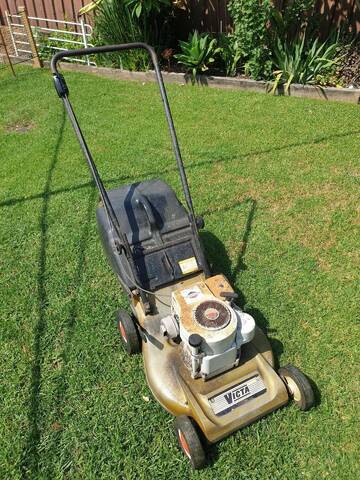
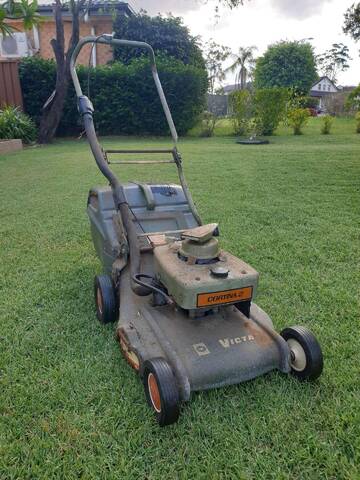
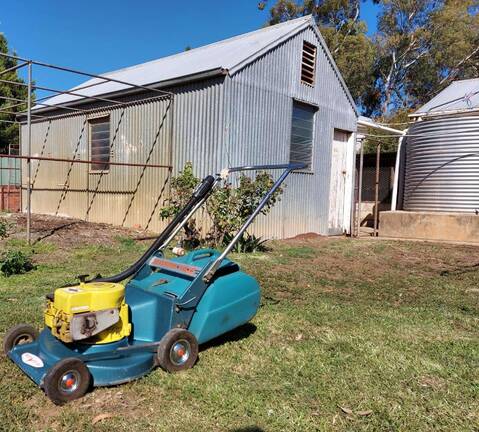
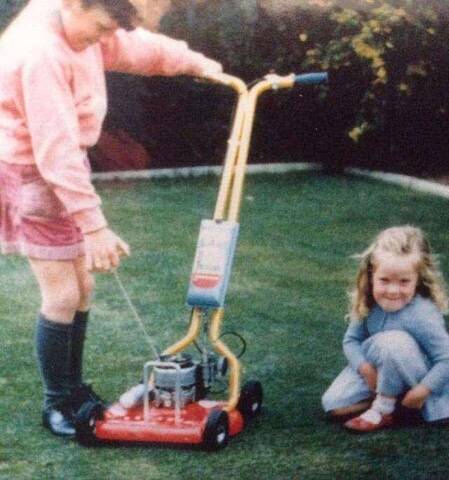
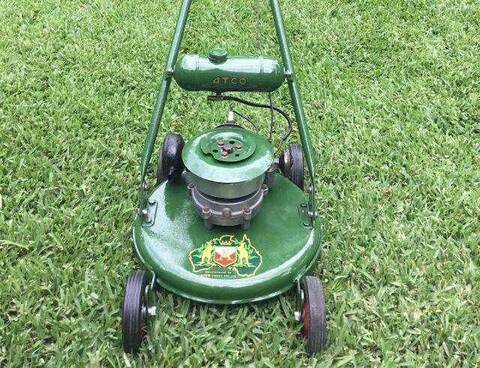
I have a copy of three patents from the same inventor ,the handle bar clamp is for a Pace mower and the catcher is for a pace mower and I was wondering if any one recognizes the self drive mower.
Pace, owned by Victa at this time, certainly looked to inventions that gave them an advantage.
And Pace was given autonomy from Victa - to pursue different designs. Full credit to Merv there!
The handle adjuster was a good one let down by plastics that did fail. This was a popular replacement part in the day.
Supa-Swift took advantage of the same patent but made the adjusters as die-cast pieces. These rarely failed.
The catcher design is unique to pace. It had some merit but the age of the plastic catcher - just a few years' away - killed the idea.
Finally, the friction drive ... To my knowledge, no manufacturer took up this one. I note the patent was lodged a few months after Rover's posi-drive system. Both used friction. Rover's was external to the rear wheels; Thompson's was internal (within the wheel).
I guess the drive system was not adopted because it lacked a differential. And all friction drives have high-wear components.
Sincere thanks for giving new life to George Milroy Thompson. Great research!
Hi Jack, thanks for that info.,I could not recall ever seeing this friction drive mower.
Some people believe self drive mowers with the friction drive on the outside of the wheel to be the most reliable and robust drive unit around for a self drive mower.
With the Pace handle bar adjuster I thought it was interesting that it mentioned the side toothed members (16) were made out of plastic and no reference for die-cast that Supa-Swift used.
G'day Gizmo We are lucky that you posted a great example of Pace using two of the Thompson patents. Great images! Thank you.
Quote
Some people believe self drive mowers with the friction drive on the outside of the wheel to be the most reliable and robust drive unit around for a self drive mower.
G'day Max I have fond memories (as a teenager) of using Rover 32s with Posi-drive. They were robust and reliable - but annoying when turning.
I guess what 'killed' dog drives was safety, but also inflated parts costs in the modern era. As you know, external friction drives - acting on drive wheels - were used on many commercial slashers - Cox, Greenfield, Rover HD25; and on may ride-ons, etc.
I like well-sorted friction drive. The North-American Snapper was a prime example of this. A variable speed friction plate acting through a differential was just brilliant.
Max, you have a Pace side catcher! As an option of the day, these catchers must be super rare!
G'day Jack. Yes a lot of manufacturers used the friction drive ,I've had a few of them along the way,Victa,Masport slasher,Rover,Mobilco and I had a ride on mower a long time ago with a variable speed friction plate acting through a differential ,I think it was an Ariens.
No that Pace with the catcher is not mine ,if I say I was just reading an old thread on ODK ,I mean I just read it again,I usually check them out over and over again,I was looking at this link click here again and thought it was a good example for the adjusting handle.
I have not seen many of those pace catchers so yes they must be super rare.
G'day Max Thanks for correcting my misunderstanding about the catcher. The ODK site is so large it's hard to recognise all pages here.
Great advances have been made in the last few years to improve searchability. But it is a never-ending story of maintenance.
Friction drives have proven themselves and are historically important. I mean, gang mowers, for example, were the 1920s invention that enabled larger areas of grass to be cut! Thank you friction.
I guess my focus was on friction drives on pedestrian machines. It was the Snapper walk-behinds that most impressed me.
The Snapper Ride-ons in your images bring back memories. Their sophisticated friction drive and reduction box made the Rover Ranger look ... very old indeed.
Since c1970s, the friction drive has become increasingly outdated. Hydraulic drive, aircraft cable drive, and now electric motor drive are all eclipsing the friction drive. But friction drives still remain - and are the cheapest option in many cases [example: belt drive systems].
Yes, my understanding is that the rare Mobilco ride-on was a North American Ariens Emperor made under licence here.
The ODK site being the size it is I would not expect anyone could remember every image.
G'day Max I don't even remember my own posts
Your finding that 1904 patent reminded me of how inventions are rarely sue generis, but are inspired by something other, natural or man-made. Or that man is capable of making amazing metaphorical connections - from falling apples to gravity.
I mean, The Wright brothers were keen observers of bird flight, but as bicycle makers, were also exposed to gearing and chain-drives. Their 'wing warping' system of control is said to have been inspired, not by a bicycle tube, but its cardboard packaging. The box could be made to warp!
Similarly, the first mechanical lawnmower - Buddings Patent - was inspired by observing the machine that removed the nap off cloth in the textile industry.
Your post reminded me of Victa's snorkel patent. I looked at that patent and one reference was for a car snorkel system from 1926! Merv, as a then car salesman, may have encountered one decades before his own 1955 patent.
Hi Jack, It's more than likely Merv saw a car snorkel system ,especially since his ideas for a rotary lawn mower came after he had inspected another inventors mower.
It is amazing when people like the wright brothers get an invention to work for the first time.
I have wondered if Supa-Swift thought of their name from the SWIFTSURE hot water system.
It's more than likely Merv saw a car snorkel system ,especially since his ideas for a rotary lawn mower came after he had inspected another inventors mower.
G'day Max That's a good point. When I wrote about the Mowhall I noted the snorkel system running through the handle bar.
I have wondered if Supa-Swift thought of their name from the SWIFTSURE hot water system.
I don't think so ... (?) Swiftsure were a Sydney company. The Swift Bros operated as a Melbourne company. I guess 'swift' was a marketing-convenient name.
Great work on the electric start patent! By the late 1960s, North American small engine makers were offering electric starts. I guess your research shows that the Eaton patent was adopted as the Tecumseh system. Briggs had one too at this time.
Both Victa and Turner offered the Tecumseh-Eaton electric starter.
I think Eaton were famous for their transmission systems too, like hydrostats on early ride-ons. I think this same company survives today:-
Hi Jack, Thanks for that I was way off with the Swiftsure thought.
Yes Eaton have a lot of transmission systems and I think it was discussed on ODK before that Eaton had the patent for the Spring Starter.
I have been looking at an idea that Vulcan did have a role in building the Supa-Swift utility in the 1960 s ( first model big bob) all speculation no proof but I was looking at Vulcan Electrics in Burwood Victoria as a possibility.





 Thank you