Has anybody fitted an ignition module from a Powertorque to a points ignition full crank. I see no reason why it would not work, just curious if anybody has tried it
What always frustrates me Norm is there are lots of people out there who claim to have done these electronic conversions, but they never seem to offer any advice or support to others. Also I see only a few promotional videos on YouTube about ignition conversion but they rarely show the engine actually being started and running after making the conversion. Only one video showed sparking after the conversion but the engine would not start. In that case the timing had to be altered on the engine to cater for the new device. Many of the videos are just mock ups to show how to install the modules. Others simply show sparking, but they don't actually show the engine working. This has led me to be very suspicious of these newfangled electronic ignition modules.
I have really only had success to date with 70s era Briggs engines that have flywheels with the long series of magnets. You can put the newer types of coils which have an ignition sensor built in and they will work perfectly. I am currently about to try a Stens ignition module on a Briggs but I am far from being hopeful that it will work. My past experience with these modules on Kirby Lauson engines has been extremely poor. The timing was in all cases impaired badly, to the point that it was impossible to attempt a start without getting a severe backfire which was often so extreme it would instantly strip off the keyway. In one case the misfire broke the armature on the magneto and also badly damaged the shaft. I give these ignition modules a big thumbs down for use on 60s and 70s Kirby Lauson and Kirby Tecumseh engines. My advice, they won't work on those engines, so don't bother trying. If anything they will only succeed in destroying them. Briggs are similar engines to Tecumseh, so I am rather skeptical and cautious. I bet my latest experiment will also end in a dramatic misfire and a broken keyway!
Basically I am beginning to wonder if the whole idea of these electronic modules being a "cure all" for replacing a points ignition system is just a lot of "smoke and mirrors".
But I hope somebody can answer your question about Powertorque. I have heard of people doing it. Once again I say "heard". I have never actually seen the engines working as claimed.
I also get the impression these ignition modules work better on 2-stroke engines than 4-stroke, generally speaking. But the makers claim that they will work on any engine, 2-stroke or 4-stroke, providing it has only 2 magnets on the flywheel and either a 2 or 3 armature coil. Well I have tried them on the old Kirby 4-strokes matching those requirements, but have never been able to get them to work. In all cases on 4 stroke Kirby engines I found the sparking to be erratic and so the timing was seriously effected.
VM I found a module sitting on the bench, no idea what it came off, the fact it was there means I had pulled it off something at some time, obviously thinking it didn't work, so I tried it on a full crank Victa 24 and it fired straight up. I will pull a Powertorque module off and try it on a full crank if I get a chance in the next few days..If I have an old points Briggs here I will try a module on that and see if it works just to let you know
Interesting Gizmo, any idea what the difference is? I thought all that happens with the 4 stroke is it ends up with a wasted spark and this is what happens with all single cylinder 4 strokes unless the ignition is driven off one of the cams at half engine revs
I think it will work. I had a generic Powertorque on a full crank and it worked well. It had a spade connector at the actual module but came with bits of wire to connect it up. I ended up putting the old one back on as that was not the problem with the full crank anyway.
Hi All, This is what I have heard on the issue with replacing points with a module.
Atom Automatically adjust the ignition timing to the same firing position as the original breaker points which other electronic modules cannot do thus prevents overheating, backfiring, engine damage, etc.
Colour coding is for ignition timing.Green,Blue ,Brown,Yellow,Red,Orange,White,Purple,Pink.
Sometimes the timing is wrong without the right module.I have heard of rekeying the flywheel to get the timing right when using the wrong module.
Gizmo, the following brands are frequently advertized as suitable for 2 and 4 stroke, providing there are only 2 magnets on the flywheel:SIG-01 (the one in your link), NOVA-II, and the almost identical STENS.
Some of these newer ones are said to be able to detect the correct moment to spark the instant the flywheel magnets rotate past the coil. So technically the timing should be the same as with points and condensor. Why it is not on some engines using some brands of ignition modules is a mystery to me. Perhaps the few I have experimented with in the past were all faulty. I bought mine from ebay and worry a bit that unscrupulous people may have tried these modules and wired them incorrectly, thus frying the circuitry, and then sent them back to the seller for a refund. One would assume the seller would not re-sell potentially faulty returned products like these, or at least test them... but this is ebay we are talking about! I am sure I could not have been so unlucky as to purchase 3 faulty ignition modules all at once, but I guess this is not outside the bounds of probability.
I have just posted this on another thread. I am currently converting ignition on an old Briggs and Stratton 3HP. The STENS module arrived in the post and it only took me a few minutes to install. I am a bit concerned about it. There is plenty of spark, but it is not an even spark as I would expect. When I spin the flywheel I seem to be getting too many sparks per rotation. Perhaps this doesn't matter as it is just making "irrelevant" sparks, but it worries me a bit that the timing may go completely haywire when I attempt to start it. I can only try it I guess and hope for the best!
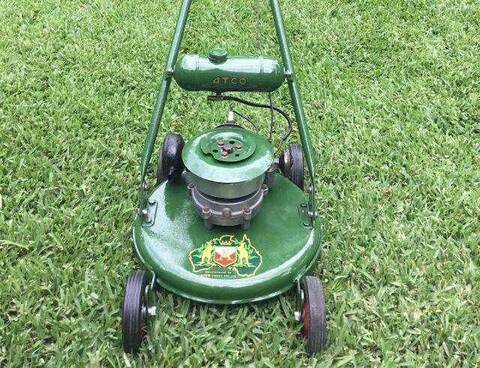
Ok I can confirm that a Powertorque module will work fine on a full crank. I just fitted one on a full crank 550 and it works fine. The next thing is does anybody know how Victa set up the blade carrier boss on these, I have not come across this before where it is held on by a bolt up into the crank similar to a Briggs fitted on a Victa. This is self propelled so it has the drive belt running off the shaft. I wasn't going to pull the motor off because a mate wants it and that is why I pulled it out from the garage, but I think it might be important for future reference if I take some pics of it. I also had a bloke drop a 550 in last night and that was fitted with a standard Powertorque and this is probably why this one is not self propelled. My thoughts are they probably put an extension boss on the crank that incorporated the drive pulley and probably lifted the motor up on spacers to suit to keep the blades at the correct height?
Just drill a hole and pop rivet it, bit of a pain because they used 5/32 diameter rivets and I put it on the top side of the plate so the fan can help keep it cool. When they are on the underside they are suffering from heat rising off the barrel
Hi MF, it doesn't matter where it goes and I assume it needs to be earthed to the body, I have never tested that theory. Position has nothing to do with the timing.
Well that clears things up. I thought the coil was the module and called the module the chip! Many thanks for putting up the pic NormK! I am confident now that I'll get my Victa Charger going real soon as I think this module is the culprit to getting no spark. I'm glad I had the foresight to remove a module as a spare from a siezed PT a while ago. You were saying in a post a while ago that the FC modules fail more often due to lack of cooling. This is a sensible and simple solution. I think I'll so treat my other two side pull full cranks.
PS won't the module wire get in the way when putting back the fan shroud?
Last edited by Mowerfreak; 14/10/1801:04 PM.
Ahh, if only victa had kept producing the thumblatch catcher series, they would be in better shape today!
With the module wire you just tuck it in beside the coil, there is enough space in there for the wire to come through. With that 550 on the bench when I got it I thought the motor was probably toast, had no muffler, no shroud, was covered in rubbish but after finding it had no spark I swapped out the module, put a modified carby on it and with a few pulls it fired up and now runs like a beauty. Another interesting thing I found was the blade carrier on these is only 5mm difference in the hole centers of a standard blade carrier, it is just that they use the blades off a 24 to get the bigger cutting width
Just drill a hole and pop rivet it, bit of a pain because they used 5/32 diameter rivets and I put it on the top side of the plate so the fan van help keep it cool. When they are on the underside they are suffering from heat rising off the barrel
Did you drill a new hole or just use the existing one it was originally mounted underneath by? Would a 4.0mm or 4.8mm diameter rivet suffice?
PS: I could work it out myself if I was home the moment.
Last edited by Mowerfreak; 14/10/1804:45 PM.
Ahh, if only victa had kept producing the thumblatch catcher series, they would be in better shape today!
I don't know I think I use 4mm (3/16th) but that causes me grief trying to drill the module out to 3/16th. I drill a new hole so the module clears the cowl .