|
0 members (),
2,501
guests, and
2,302
robots. |
|
Key:
Admin,
Global Mod,
Mod
|
|
|
|
Joined: Jan 2017
Posts: 760 Likes: 4
Senior Contributor
|
I need to know if this is the correct position for the governor on a Kirby-Lauson VK-30. Please note that the fastening screw is in the upright position, with screw head facing up. The governor arm is forming a right angle at this position. Is this correct? ![[Linked Image]](https://www.outdoorking-forum.com.au/forum/uploads/usergals/2017/07/full-10975-35176-full_10975_35026b.jpg)
|
|
|
|
|
Joined: Jan 2017
Posts: 760 Likes: 4
Senior Contributor
|
This thread can probably be deleted now, as my Kirby-Lauson decided to give up the ghost. I have stripped it down for spare parts and recycled the much needed Zenith AH914 carby into a Southern Cross KXD-2 engine.
I am fairly sure these are the correct positions, as they match well with a photo I saw recently of a working engine. There is still some doubt about the governor lever positions, but really this seems to be the only logical position.
My problem was that I purchased an engine that came with the linkages mixed up, so I was really working blind from the word go.
Something I am finding interesting is that there seems to be a distinct lack of Kirby-Lauson experts on this forum and others, which is surprising, considering how popular these engines were in the not so distant past. Ask a question and nobody seems to know.
Mind you I knew plenty of people back in the day who would not touch Kirby Lauson or Tecumseh engines from that era. But we are all like that as individuals. We all have engines we like and other engines we do not. Some people preferred Fords, others Holdens, and so it goes.
What I do not like personally is that the manuals for Kirby-Lauson were all printed with microscopic illustrations that show little resemblance to the real world. The instruction manuals only tell you the basics, like what spark plug to use and the gap and how to change the oil, and that is about it. We have come to expect this from today's Chinese-made mowers, but really I did not expect it from an engine of that vintage. The Kirby-Lauson and Briggs and Stratton were like the precursor designs for today's cheap, mass produced Chinese engines.
I don't like them from the point of view that they are too difficult to work on. For example as soon as you pull the crankcase apart on the Kirby-Lauson to do something as simple as change a gasket, everything inside starts to fall out. What a stupid design!
However I have an old Rover with a B&S engine and it has shown no signs of dying after two decades of use, but it is starting to show its age too with various "foibles" creeping into it. I understand the foibles. Give it to someone else and they probably would not even be able to start it.
|
|
|
|
|
Joined: Jan 2016
Posts: 8,210 Likes: 234
SENIOR TECHNICIAN
|
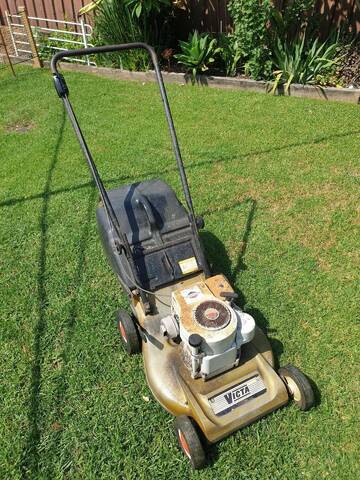
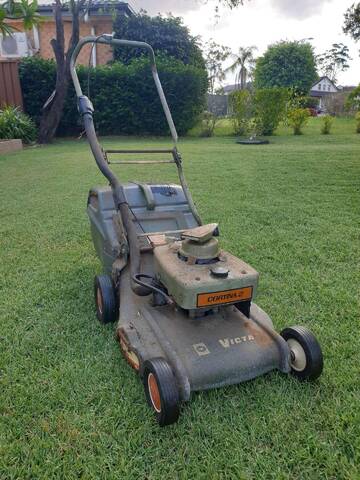
And here lies the reason the Victa 2 stroke motors were and are so far ahead of the rest of the small engine stuff on the market then and still to this day. All those little components in these small motors all having to do their job in a blink of an eye and if not failure. And over revving an old motor like that will often have terminal results
|
|
|
|
|
Joined: Jan 2017
Posts: 760 Likes: 4
Senior Contributor
|
Norm, you only assume I over-revved it. You were not here. Although it was running a bit fast I would not say it was running overly-fast. The problem was that even though I immediately pulled the throttle position from choke back to near stop, it kept running at the same speed. Was this a problem with the carby or governor? Perhaps. All I know is it all happened in about 5 seconds, in the blink of an eye. And I have since learned that I had everything set correctly. I still maintain it was a combination of worn out parts, metal fatigue, age, and, as you suggest, too many weak little components. If you could see that camshaft and how brittle the metal is, you would soon see what I mean. It is like chalk. In fact exactly like chalk. And this part has to push the valves up and down. No wonder it failed.
Over-revving a restored engine is often difficult to avoid. In fact three out of five of the Southern Cross engines I restored did over-rev on their first start. This seems to have been due to worn governors. In their case I had to physically tighten the springs on to the governor arm so that I could push the governor lever as far back as possible with the throttle control in order to get them to idle. Once I can get them to idle it is then a fairly easy job to sort out the correct speeds with the control. Not every old engine is the same, even if they are the same make and model. They all start differently and sound different when running.
A lot of it is just luck of the draw when it comes to restoration. Old parts are bound to fail, sooner if not later. That is a fact of life that I am prepared to accept. It is possibly far better if they fail straight away than later on, like after I've sold the mower to someone else for example. But I guess then I can blame the new owner for over-revving it? lol!
|
|
|
|
M |
T |
W |
T |
F |
S |
S |
|
|
|
|
|
|
1
|
2
|
|
3
|
4
|
5
|
6
|
7
|
8
|
9
|
|
10
|
11
|
12
|
13
|
14
|
15
|
16
|
|
17
|
18
|
19
|
20
|
21
|
22
|
23
|
|
24
|
25
|
26
|
27
|
28
|
29
|
30
|
|
31
|
|
|
|
|
|
|
|
|
Forums144
Topics12,748
Posts106,774
Members18,085
| |
Most Online40,124
Apr 13th, 2026
|
|
|
|