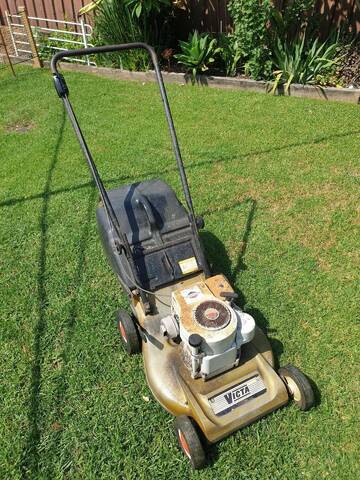
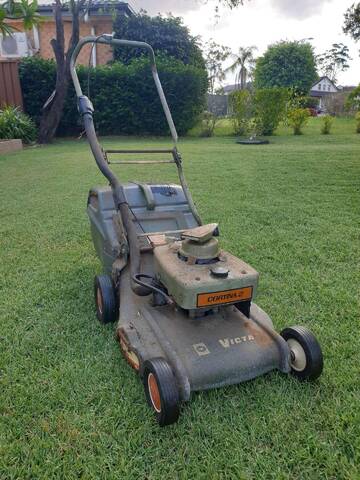
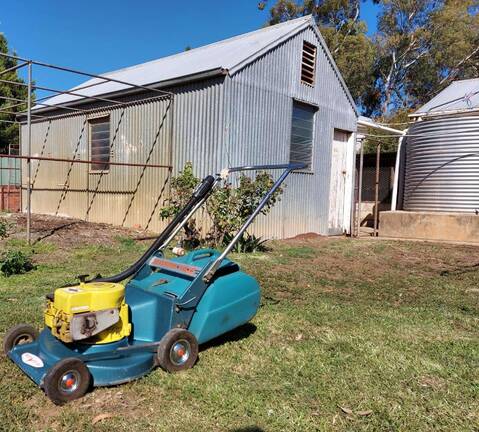
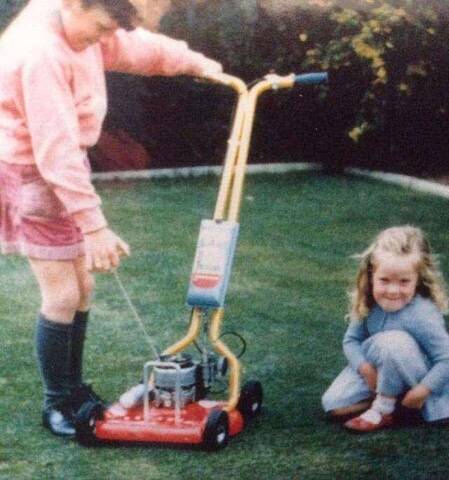
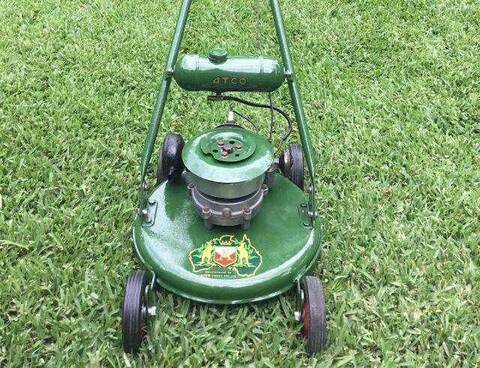
Just wondering how old this mower would be. Have rung a mower place who said don't bother trying to fix the carby on this, change it over to the carby that came later with a priming bulb, apparently the original carbys were problematic. What do the wise heads say? Mower is otherwise fine. Tried to add photos but can't see them in the Preview. The mower is a Rover ES200 XL , is red and the model number is 92508.
Last edited by CyberJack; 02/05/1705:45 PM. Reason: Topic Heading.
That is a Briggs 92508, probably from the early 1980s. It has a VacuJet carburetor with an automatic choke. It was a nice, reliable carburetor that made the mower easier to use than the later PulsaPrime with the primer bulb, but some service places do not read the Briggs manual, and as a result have problems servicing the automatic choke.
If you decide to change to a PulsaPrime carburetor you will need to get the whole carburetor and fuel tank as an assembly - you can't use a VacuJet tank with a PulsaPrime carburetor.
First, if you are going to separate the carburetor from the fuel tank, you need to read the Briggs manual.
Second, for all of the side valve engines AFAIK, Briggs specifies SAE30 engine oil, meeting American Petroleum Institute standards (SF, SG, SH, etc. - they keep bringing out new ones). Briggs says you can use, say, SAE 20W-30, but you should expect to burn quite a bit more of it than you would with straight SAE30. Outdoorking members seem to have verified the truth of this warning.
G'day Roebuck, it looks like a nice machine, think I'll put some time into mine, most mowers I've worked on have been a little too loud for my liking so if this one is a little quieter that will be good for neighbours and for me .
roebuck, if you want to know the engine's date of manufacture, just tell us the engine's code. One of your pictures shows the model (92508) and type (5157-01), stamped on the cooling cowl - just to the right of the type is another block of numbers which is the code.
Gday Grumpy' my b&s model 92908 type 5185 01 code 8708 2004 I think tiger at the beginning wanted to know. I'm interested in this engine aswell. Hp is 3 1/2 I think.
The 9 cubic inch 92908 was advertised as 3.5 hp until 1982 I think. Then both 92908 (PulsaJet version) and 92508 (VacuJet version) were derated to 3 hp. The explanation Briggs gave focused on the fact that they had to reduce the maximum governed speed of the vertical crankshaft engines from 3,500 rpm to 3,000 rpm because of safety concerns relating to blade tip speed and how hard the blades could throw stones. The horizontal crankshaft versions continued to be governed to 3,500 rpm. I don't recall them increasing the advertised power of the 9 cubic inch vertical crankshaft engines after that, but I could be wrong. Nowadays they avoid referring to power output, having lost a lawsuit on the subject of advertised power. They got away with it for several decades before that happened. The advertised 3 hp was probably less than 2 hp when the engine was trimmed and fitted to a mower. Briggs was not the only culprit - it was usual practice for engine manufacturers to advertise gross power, not nett power. The same thing was done by car manufacturers up until the 1970s, then they switched to nett power to avoid the same kind of litigation that the small engine people encountered in the 2000s. So, if you know someone with a 1960s or 70s muscle car who brags about its power, just snigger a bit and move on. The horses were very small ponies in those days.
My mower's code is 92508 5157 01 85102505, so I'm tipping that the engine was manufactured in 1985.
It has a Vacu-jet carby which I don't have much experience with. Once I get the carby/fuel tank off the mower I should be right but I've had problems with the governor/throttle linkages. Is the process for taking the Vacu-jet off the same as for the Pulsa-jets?
Tiger, your engine's manufacture date was 25 October, 1985, and it was made in Briggs' Poplar Bluff, Missouri, engine plant.
The VacuJet carburetor was a cheaper alternative to the more complicated PulsaJet. The difference was that the VacuJet used carburetor venturi suction to suck fuel up from the fuel tank, through the main jet, to the discharge nozzles. The PulsaJet had a fuel pump which continuously pumped fuel up to a small secondary fuel tank in the top of the main fuel tank, allowing the secondary tank to overflow continuously. Venturi vacuum just had to suck the fuel up the very small, and precisely constant, distance from the top of the secondary tank to the discharge nozzles. This made the air/fuel ratio considerably more consistent in the PulsaJet. In practice the VacuJet is rather unsatisfactory in the deep fuel tanks used on horizontal crankshaft engines, but it was not really an issue with the shallow tanks on the vertical crankshaft engines.
The downside of the PulsaJet on vertical crankshaft engines is that its fuel pump diaphragm (including the pump's flap valves) is sandwiched between the fuel tank and carburetor, instead of just having a gasket there as the VacuJet does. This means the vertical crankshaft PulsaJet requires more care in assembly to the tank, than the VacuJet does. In the case of the 92000 series engines, which had automatic chokes, the PulsaJet's diaphragm had to be pre-loaded when assembling the fuel tank to the carburetor, and this requirement has been the downfall of many mower repair shops which failed to do it, thus preventing the choke from working and the mower from starting. Some of the unsuccessful mechanics then waged a public relations war against both PulsaJet and VacuJet, recommending use of the PulsaPrime.
The VacuJet is considerably easier to work on than the PulsaJet, but I suggest you should read the Briggs manual and follow its instructions.
So far as removing the carburetor and fuel tank, as an assembly, from the engine is concerned, the process is much the same for PulsaJet or VacuJet - the governor link is a bit of a pain for both, but it's nothing major. The rubber breather elbow looks the same for both but it isn't, you need to use the correct one or it won't fit properly.
I'm going to have a go at this machine tonight, I have a Briggs Small engine book which shows what to do in order to take the carby off the petrol tank but I can't find anything that describes the very first stage where you take the snorkel off the petrol tank. I'm assuming that you just unscrew the snorkel off but are there any other precautions to take here?
Briggs did not make the snorkel, so it isn't covered in their manuals. You remove it in the same way as a normal Briggs air cleaner: just undo the central vertical screw, and you can lift off the little air box under it. Remember though, you must put that screw back in to run the engine. You don't need the air cleaner, but you do need that screw, or it will become very rich - perhaps too rich to even run.
You then have to remove the air cowl, then the vertical pull starter, before you can take the tank and carburetor off as a single unit.
Thanks Grumpy that explains it, I've spent a bit of time searching the net trying to find a similar set-up with the snorkel but found nothing, obviously not something that caught on so it (snorkel) was discarded.
The snorkels are quite popular with some users, tiger, but they have always been supplied by mower manufacturers, not engine manufacturers so their designs are perhaps a bit less professional than genuine engine parts. They have a lot to offer heavy users, such as contractors, because they take a lot longer to clog under dusty conditions. I think they may have become mainly aftermarket items though, now that mowers are mainly commodity goods made in China, rather than something people think about before buying.
I have the impression the mower shops that offer machines assembled from imported parts tailored for specific types of customer, are making inroads into the contractor market. One reason would be that they can easily undercut Honda prices with a very similar machine. However another benefit they can offer is carefully tailored specifications that suit contractor preferences.
Would have to heartily agree with Roebuck and Nathan, these are very smooth and pretty quiet. The carby had mud everywhere, once I took it apart and cleaned it, it runs fine. Why are these mowers so smooth, is it the engine design? Wheels? Just trying to understand what makes them so good.
I agree they are rather quiet and smooth, but I don't think you should exaggerate this. A while ago I had 2 mowers: a Victa Impala 4 with a 1976 Briggs 92908, and a Rover 200ES with a 1983 Briggs 92508. Both were very smooth, easy to start, and all that good stuff. The Victa was the nicer mower, due to a comfort handle with a good vibration isolation mechanism. The Rover was much quieter, because it had a large muffler where the Victa just had a little pot muffler. I liked both mowers, until I got an early Honda HR194 (4 height levers & bar blade, made in the mid 1980s). The Honda was so much quieter and smoother there was no comparison. Then I got a Honda HRU195 from about 2007. It was even quieter and smoother than the HR194: I could mow with the engine idling, and the loudest sound I could hear was the grass rushing around the grass scroll into the catcher. Of course mowing with the engine idling was not practical, since the cut wasn't totally smooth and the catcher chute tended to clog, but it sounded great.
So, that Rover is smooth and quiet because the version of the Briggs 92508 made for Rover was a smooth quiet engine with a good muffler. However it was not state of the art even for the mid 1980s: the Honda GXV120 was in a higher class altogether. I loved my Briggs mowers when I had them, because they were far and away the best I'd ever had up until then. But now I'm spoiled - I've walked right past similar Rovers on nature strips.
Thanks Grumpy, I guess my experience is rather limited but of all the machines I've seen the Rover is the quietest/smoothest. So in part the mower is quiet because it has a big muffler. You mentioned that the Briggs 92508 engine was a quiet engine, do you know how they make it quieter?
Just a gentle nod, this is getting way off topic guys.Time to wind it up.
Please do not PM me asking for support. Please post your questions in the appropriate forums, as the replies it may receive may help all members, not just the individual member. Kindest Regards, Darryl
Darryl is right tiger, this is not the right place to continue. As a final response, the 92508 and 92908 were the same engine with a different carburetor/fuel tank. The reason the early 1980s Rover 92508 was quiet, was the large and effective muffler it had. Briggs offered the big muffler and the little pot muffler as alternatives, and mower manufacturers chose what they wanted. On my 1976 mower, Victa specified the little pot muffler - perhaps the bigger, better muffler hadn't been introduced at that time, or perhaps they were crazy. More likely, because the engine was laid out with the cylinder crossways on the Victa, and longitudinally on the Rover, perhaps there wasn't room for the big muffler running crossways on the Victa, because of the high arch grass chute. On my 1983 mower, Rover specified the big muffler, and I'm very glad they did. That one change made their mower a nicer machine.
As this topic has reached a conclusion, I will now close it. If any member has anything to add, please PM a moderator.
Please do not PM me asking for support. Please post your questions in the appropriate forums, as the replies it may receive may help all members, not just the individual member. Kindest Regards, Darryl


![[Linked Image]](https://www.outdoorking-forum.com.au/forum/uploads/usergals/2013/06/full-6680-11352-imag0023.jpg)
 .
.