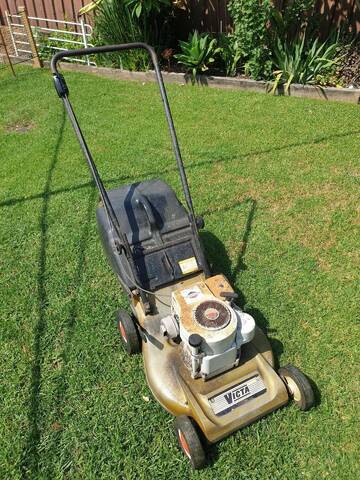
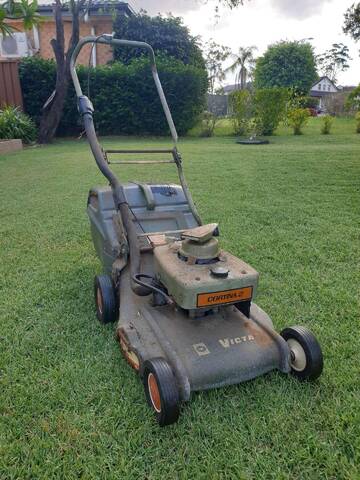
Hi, I'm after some advice regarding my Honda GCV160 (Victa body) lawn mower. I bought this mower from Bunnings about 18 months ago and until recently it has been fantastic.
I have an extremely small area of lawn so it really hasn't had much use.
Now I have a bit of a problem. It won't run smoothly. The revs go up and down a bit and the engine dies when reducing the throttle position down past about half way.
I recently lent the mower to a neighbour and he ran it out of fuel so I'm thinking this could have caused the carby to gunk up. The mower starts ok. I've put new fuel in which made no difference.
Does anyone have any suggestions? I am mechanically minded but know next to nothing about carburettors so any advice relating to the carby would probably need to be fairly detailed.
I was just going to take it somewhere to get fixed but I found this forum so thought I'd try my luck. I'm thinking I will probably get ripped off by taking it to a mower place.
Running it out of fuel wont have caused the carby to gunk up, but something is making it run lean, it could well be worth dropping the float bowl off the bottom of the carby and taking a look inside, its unlikely to have much if any dirt inside unless the strainer in the tank has become damaged.
The gcv160 motor is quite a fussy beast, they do not like fuel that isnt 100% fresh, I had one coming in regularly with stale fuel, it was after the third time I tipped out and replenished the fuel its owners decided to throw away their $5 in fuel in the old can and get fresh stuff.
Also if they get any water in the fuel system, they can behave very irratically, such water will be seen in the fuel bowl when removed along with any dirt that may have built up, if there is evidence of either, it would be a good idea to clean the jet out.
It sounds as if it might be lean mixture, but we'd need to know more about the symptoms to clarify this, and start working toward the cause. 1. Does it start easily from cold on full choke? 2. How long after a cold start is the earliest you can you move the speed control away from the choke position? 3. Does it run smoothly at all speed settings after warm up, or does it hunt (vary up and down in speed) at some speed settings? 4. How does it handle load (mowing grass) when set at maximum speed? 5. Is the bottom of the fuel tank clean, or is there rubbish in there? 6. Have you tested the spark? (Remove the spark plug, connect it to the lead and clamp it to a metal part of the engine, then pull the starter cord.)
It starts very easily. I can move the lever off choke position after about 15 to 20 seconds. It then starts to hunt almost straight away. It hunts at all speed settings but dies completely at about half throttle. Was good under load until this started happening. It still runs under load but not quite as well. The tank is clean. The spark plug is a little black but not oily.
The mower has probably only done about 8 to 10 hours in total since I bought it new.
I haven't tested the spark. I can try that on the weekend though.
You should begin by testing the spark, as discussed previously. If the spark is satisfactory, the next step would be to inspect and clean the fuel filter. Instructions for that are on Page 79 of the workshop manual, which you can get here:
If the filter and fuel line are clear, in view of the fact that the problem arose after you lent it to a neighbour (something I would never do, by the way - you now know why) check that there has not been interference with the governor mechanism, in particular the anti-oscillation spring. The anti-oscillation spring is the small one at the top of the picture, slid over the outside of the wire link between the governor arm and the throttle butterfly. Also check the rest of the governor external mechanism, to make sure it looks just like the one in that diagram, with all of the parts connected just as shown. While you are at it, go through the simple process on Page 79 for adjusting the governor.
If all is in order with the fuel feed system and the governor, the next step would be to clean the carburetor's main jet and emulsifier, but I suggest you refrain from touching the carburetor until you've been through the process outlined above. Then if you post a progress report to this thread, we can talk about how to proceed from there. It seems to me that more Honda mowers get scrapped because someone has attacked the carburetor unnecessarily, than for any other reason.
I'm getting a good continuous spark. I've previously emptied, cleaned and checked the tank and filter and all is good there. The governor mechanism all appears fine to my eye. The anti-oscillation spring seems to be moving freely and extends properly when manually moving the governor arm.
Now, adjusting the governor? Do I just use my ear to set the engine speed? I don't have anything else to measure it at the 3100rpm. I hope this isn't a stupid question!!!!
I don't think it is worth buying a tachometer just to set the maximum engine speed, which is probably close to correct anyway if the governor is undamaged. On the GCV engines there is no adjustment for maximum speed except choosing between the two holes where the governor spring attaches to the bottom end of the governor arm. Your engine seems to be set for the "normal" maximum speed, the other hole in the arm would give a higher maximum speed. I suggest you leave the setting as it is.
By way of background, the GCV series of engines appears to have been designed as a reduced-cost series, after the GXV engines had been in production for a time. The GXV engines have pushrod valve gear, detachable cylinder heads, and lots of adjustments and oil seals. The GCVs don't. The GCVs appear to be what I would describe as throwaway engines: they have a rubber belt driving the camshaft, and when it stretches and slips, the crankcase has to be dismantled to replace it. Valve lapping and piston ring replacement are difficult compared with the GXV engines. None of this is very relevant to your problem, however: a GCV engine should last quite a few years in normal suburban service.
There is a possibility that your engine is fitted with the optional spark arrester, and if this has become clogged (for example through the use of dirty or inferior fuel) it is possible the excessive back pressure would cause symptoms of lean mixture, such as you have. I suggest you follow the instructions on Page 83 of the manual, and if the spark arrester is fitted, ensure that it is clear.
Look at the pilot screw (Page 77). Essentially this is just an idle mixture adjustment with a rather limited effect, and on current engines it is normally not adjustable anyway: a movement limiter is attached to the head of the screw. If it has the limiter, you are probably stuck with that, because it is not appropriate for me to tell you, and everyone else who visits this site, how to defeat it. Note: do not try to remove it by force, it is deliberately designed to break the brass screw off if you do that.
Please post a picture of the float bowl area of your carburetor. I will then go through the process for cleaning the main jet and emulsifier.
OK - I don't think I have the optional spark arrester:
The pilot screw doesn't appear to be adjustable. It has a different head to the throttle stop screw. The pilot screw has a groove suitable for a standard screw driver but the head has a bit coming off one side which would restrict its ability to turn. Due to the position it would be difficult to get a photo of it but I could try if that would help.
As far as posting the float bowl picture: Is this what you're after or should I try again. Just let me know. I can take as many photos as is necessary.
You have the standard tamper-proof pilot screw, so you shouldn't plan on adjusting it, or removing it for cleaning. That isn't too serious, you can clean around it if cleaning the whole carburetor becomes necessary. In real extremity I can even tell you how to adjust it.
I suggest you see if you can put a small container underneath that retaining screw that is in the center of the bottom of the float bowl. If you can put a container there, turn off the fuel and loosen the float bowl retaining screw. Fuel (and just possibly water) will flow out into the container until the float bowl is empty. Remove the container and look closely to see if it contains any water as well as the fuel. If it does, you've found your problem. Whether there is water or not, take out the retaining screw. The float bowl will drop off into your hand. Check inside the bowl for signs of dirt or water. Put the container back under the carburetor and turn on the fuel tap. See if fuel flows full stream out of the entry port on the underside of the carburetor body, above the pivoted side of the plastic float.
There is a very good chance you have water in your float bowl - it fits the circumstances well, since the problem happened suddenly when the machine was in the hands of an unreliable amateur. However if there is no water, and you haven't found a problem when you get to this point (either water or restricted flow), it is time to remove the main jet. Here is an internet check sheet for servicing a Honda carburetor approximately the same as yours (the sheet is actually for a GX or GXV carburetor, so it is somewhat more advanced than yours, but has the same functions and layout):
You can see that the main jet has a thread on the outside, and it holds the emulsifier (which they call the "main nozzle") in position. If you have a suitable stumpy screwdriver which will fit below the carburetor you may be able to insert it vertically into the bottom of the carburetor, via the thread that the float bowl retaining screw came out of. At the top of that thread is the main jet, which has a screwdriver slot in its underside. If your screwdriver is a good fit in that slot, unscrew the main jet so it drops out. The emulsifier may drop out after it, but it probably won't. Inspect the hole in the center of the main jet and see if it is perfectly clean. If it is not completely clean, you will have to remove the carburetor and clean it in detail. That will probably destroy at least one of the gaskets that sandwich the plastic insulator between the carburetor and the intake port on the cylinder head. That is not an entirely bad thing, since if anyone has ever messed about with the carburetor retaining screws, they have very likely split one of the gaskets anyway, and your symptoms are a very good fit for a split and leaking insulator gasket.
I suggest you follow these notes this far and report back on what you find, whether everything is now fixed or not. If you haven't found the problem, the next step will be to remove the carburetor and go through a standard cleaning procedure, which I can help you with in detail. If that turns out to be necessary you will end up with a clean carburetor and new insulator gaskets, which should eliminate just about all of the potential causes of your symptoms except internal mechanical problems such as a leaky valve or incorrect camshaft timing.
I couldn't see any signs of water in the fuel from the float bowl but there was a small amount of fine grit in the container and around the rim of the hole where the bolt goes. There is a good flow of fuel coming from around the pivot point of the float bowl when the tap was turned back on. After putting this back together and running the engine it has improved considerably. There is now no audible signs of the "hunting" and it is running smoothly and powerfully at the max power setting. The only apparent problem now is that it still won't run when the lever is moved much below the half throttle position. I guess I will need to move on to the next step in your last post to fix this. I'm probably running out of daylight now and I'm otherwise occupied tomorrow so I'll get onto it again on Monday and post my results.
Thank you for the interim report. It sounds as if there is probably powder throughout the carburetor though, rather than just in the main jet. The deterioration in behaviour as you get down toward the idle jet's influence suggests that is partly or wholly blocked - which is not surprising since its orifices are much smaller than the main jet. Let's see how you go with a clean jet, but if that is not sufficient, the carburetor will have to come off the engine and be cleaned in detail. Not difficult, but it will cost a few dollars for gaskets and carburetor cleaner. If you were going to do this regularly I'd suggest you get the special tools recommended by Honda, but if you keep your mower closer to home in future it may never happen again, so that wouldn't be worthwhile.
There is no way that I will be able to get even my smallest stumpy screwdriver into that threaded hole while the carby is attached.
Going by what you've said so far, and the carby service checklist you attached earlier, I would think that removal of the carby is pretty much inevitable. So if you're willing to run me through that I would be very appreciative. It all looks simple enough but doing all the steps in the correct order is probably important (removing governor correctly etc).
Your instructions so far have been clear and concise so they have been easy to follow - thanks for that.
The first item that has to be removed is the air filter box. It is held by three screws, two of which also hold the carburetor to the cylinder head. The third screw is to the right of the ones that hold the carburetor. So, take the cover off the air filter and remove the element. Remove the three screws. Pull off the fairly large black breather hose that attaches to the underside of the filter box. When you have done that, the carburetor will be accessible. It may be be hanging by its linkages unless the gasket stickiness is supporting it, so don't push down on it. Slide the clip that holds the fuel hose back, then remove the hose - you may have to rotate it on its fitting first, to free it up. I tend to push them off rather than pull them off, because when you pull them the hose stretches and contracts, which makes it tighter. I usually use a screwdriver at the free end of the hose, to push it back some distance, then pull it off the last bit of the way.
Unhook the anti-oscillation spring from the throttle butterfly. Hold the carburetor and push down on it steadily to separate the sticky gasket holding the insulator to the port, or the carburetor to the insulator. You don't care which one separates. Now you are ready to remove the two wire links (throttle butterfly valve, and choke) that are still attaching the carburetor to the engine. You need to rotate the carburetor gently so you can unhook each link in turn. Then you have the carburetor in your hand, and you can tip it upside down and unscrew the main jet. Put your hand under it, tip it back the right way up, and the jet should drop into your hand. The emulsifier is only held in by the jet, but it may not drop out. If it doesn't, look into the carburetor's throat through the choke butterfly. At the throat or venturi, on the bottom side of the carburetor you'll see a small round object sticking up slightly. That is the top of the emulsifier. Gently push it downward - a small Allen key is good for this. As soon as it moves and unsticks from the petrol gum holding it, the emulsifier will drop out through the hole you took the main jet out from. It is best to clean the jet and emulsifier by spraying carburetor cleaner through them. Note that the emulsifier has about 14 holes, including the top and bottom ones, and all have to be completely clean.
Now that you have the carburetor off, I'm going to refer you to three internet videos. One is an official Honda one that shows you how to do a perfect, elegant job of cleaning a GXV120 carburetor, which is not quite the same as yours. Don't worry about the video being in Dutch, he barely speaks anyway:
The other two videos show a heavy-handed galoot cleaning a carburetor identical to yours (but on a horizontal crankshaft GC engine, not a vertical crankshaft GCV engine - this slightly changes the process for removing and reinstalling the carburetor, so follow what I've said above rather than what he does). The galoot's carburetor also has exactly the fault that I think yours has: a blocked idle jet. He finds the problem at the end of the first video, then cleans it. He puts the carburetor back together in the second video. Here are the links to the videos:
You need to clean the whole carburetor, since you will have it off the engine and it has dirt in it. The first (genuine Honda) video shows the right way to do it. However the GX carburetor has a removable idle jet, but yours has a pressed-in, non-removable idle jet, so you have to clean it in situ. The galoot pokes a bit of copper wire through it. This is good if you do it correctly, and bad if you don't, since you could end up breaking off the wire in the tiny hole in the pressed-in idle jet, which would mean it was time for a new carburetor. The idle jet has a drilled hole in it which is only 0.35 mm diameter (0.014"), so the strand of copper wire would need to be quite small to fit through it. The tool the guy uses for the job in the official Honda video is a stainless steel cleaning rod, 0.30 mm in diameter. It is actually a device made for cleaning oxy welding torch tips, but the standard set of torch cleaners only goes down to 0.4mm: you need an extended set to get a 0.3mm cleaner. Up to now I've used a 0.3mm jet drill for the job because I only have a standard set of torch cleaners - I just got around to buying an extended set by mail order but they haven't arrived yet. Edit: When they arrived, the smallest was 0.4 mm, same as a standard set. I have not been able to source an extended set. However, I digress. If you are worried about breaking the copper wire off in the jet, just blast the jet from above with the carburetor cleaner and see if the liquid sprays out from the threaded hole the main jet screws into. If you squirt the cleaner down through the hole above the idle jet, after removing the screw-in plug from it as shown in the video, liquid cleaner should come out through the main jet mounting thread. If it doesn't come out from that thread, your idle jet is blocked and has stayed blocked. In most cases the carb cleaner will successfully blow out the crud without poking the copper wire through, but you will note from the first galoot video that he fails to dislodge the crud that way and has to use the copper wire.
Once you've done all the things the galoot does, hopefully in a gentler and tidier manner, it is time to put the carburetor back together, which he also shows you how to do (it is just a reversal of the disassembly process). You will need to clean the carburetor's and cylinder head's mounting surfaces for the insulator gaskets, and fit either one or two new gaskets. I think you will find your local Honda dealer will have two kinds of gasket available: one the same as the original equipment gasket, which is dark grey, and the official Honda aftermarket one, which is made from blue paper. If you use the grey one, it seals beautifully by sticking to the two parts it is squeezed between, then always splits when you dismantle the parts. The blue paper one does not stick and is therefore re-usable. Be very clear on whether you unstuck the gaskets on both sides of the carburetor insulator, or only on one side. If they are both unstuck, they have to both be replaced. Note that trying to reinstall a split gasket is almost certain to result in an intake leak and, at best, poor idle quality, but perhaps an engine that won't even start. (That engine should idle down to 1,500 rpm or less with car-like quality. If it won't, you have a problem.) If you follow the many internet reports of "carburetor trouble" with OHV Honda engines, from the symptoms most of them are actually split insulator gaskets. In many of the cases, the owner ultimately throws the whole mower away.
It is now time to reinstall the carburetor by reversing the removal process.
Edit note for archives: Readers should note that these instructions are for the GCV or GC engines. The GXV or GX engines are slightly different: the carburetor is mounted on two studs, rather than two removable screws, and there is a removable idle jet made from black plastic.
Last edited by Bruce; 12/08/1701:45 AM. Reason: Corrected Youtube
I was unable to remove the emulsifier. It just wouldn't drop out and wouldn't budge by pushing it from the top. It seemed like it was screwed in but I decided to leave it as I was pretty sure that my main issue was with the idle jet.
All the gaskets came off easily and undamaged. I thought it would be unlikely that they would all go back on sitting in the formed indentations so was expecting to buy new ones anyway but once I put everything back together it started beautifully. After letting it run on full throttle for 5 minutes I crossed my fingers and slowly reduced the throttle down to minimum and......hey presto.......it didn't die....yippee. Before dismantling I took a photo of the idle mixture screw position so that I could screw it back in to the same position so I'm very happy that all is now working well.
Grumpy, is there an aftermarket filter that I could insert into the fuel line? I guess that sufficient flow may be a problem if it's just a gravity feed???
Anyway I would really like to thank you for all the help you have given me. I know it would have taken quite some time to put all those brilliant instructions into writing and I am very grateful. I hope that this thread is of benefit to many other people in the future.
Post-edit: In my experience so far, when the emulsifier will not drop out of one of those small Keihin carburetors used by Honda on the GX or GXV120/140/160 and the equivalent GCV engines, it is stuck due to fuel gum between the emulsifier and the carburetor body. Generally, spraying both upward through the main jet mounting passage, and downward through the venturi, with carb cleaner a couple of times will fix the problem and allow it to drop out with minor downward pressure from an Allen key. Do not apply major downward force: the emulsifier is only brass, and has a thin, counterbored, shaped upper tip that affects the carburetor tuning. Note that if the emulsifier is gummed into place, it is likely that some or all of the approximately 16 tiny holes (0.3-0.5 mm) drilled crossways through it will be closed off by gum, and the engine will therefore not run as well as it should.End of Post-Edit
very_busy, wasn't there a filter in it originally, either in the bottom of the fuel tank at the outlet, or in the fuel line? Honda puts a tiny filter inside the tank outlet fitting of the GXV120, and builds the filter into the the tank right above the outlet fitting of the GXV140. The GXV120's filter comes out with the fuel line when you pull it off the tank. The GXV140's filter can't be removed as far as I know, and you clean it by back-flushing the tank outlet fitting. If there was no filter originally, you could put a Briggs disk-shaped aftermarket filter into the fuel line. There are two types available: black for engines with fuel pumps, and red for engines without fuel pumps (gravity feed). If you use a Briggs filter, use the red (gravity feed) one. It is important to have a fuel filter in any mower engine, but it is essential with the Honda-type carburetor because of the ultra-tiny idle jet.
Thank you for reporting back on the outcome of cleaning the carburetor. I'll close this thread - if anyone needs to post to it, just PM a moderator.
Last edited by grumpy; 20/10/1307:49 PM. Reason: Add post-edit


![[Linked Image]](https://www.outdoorking-forum.com.au/forum/uploads/usergals/2012/07/full-2772-7112-honda_gcv160_governor.png)
![[Linked Image]](https://www.outdoorking-forum.com.au/forum/uploads/usergals/2012/07/full-6074-7113-lawnmower_2.jpg)
![[Linked Image]](https://www.outdoorking-forum.com.au/forum/uploads/usergals/2012/07/full-6074-7114-lawnmower_004.jpg)
![[Linked Image]](https://www.outdoorking-forum.com.au/forum/uploads/usergals/2012/07/full-6074-7115-lawnmower_005.jpg)
![[Linked Image]](https://www.outdoorking-forum.com.au/forum/uploads/usergals/2012/07/full-2772-7121-honda_carburetor_check_sheet.png)