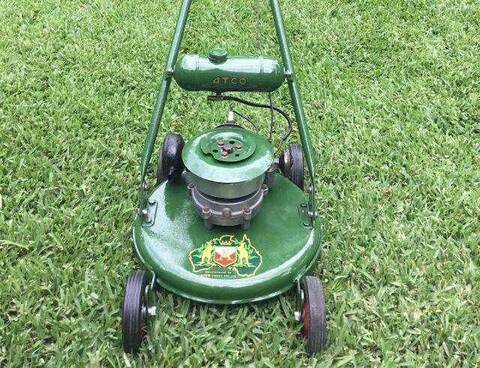
Are you sure the one with the short muffler is older? The long muffler is the same as the one that was on my 12" ATCO, and I'm told 12" ATCOs weren't made after 1936.
I honestly do not know. They are both 14 inch cut. The one with the long muffler has cast metal handles, while the one I was told was older has turned wooden handles. What should I look for in order to date them?
My 12" ATCO had the cast aluminium handles, as well as the long muffler. My only reasons for thinking that combination came before the short muffler are first, some old ATCO information I saw said they didn't make 12" mowers after 1936, and second, the fact that the short mufflers seem quite a bit more common. We've had a number of threads featuring short mufflers on ATCOs that looked like 1950s, and none of them had cast aluminium handles. They often didn't have handles at all, which is consistent with the original ones being pretty flimsy. Off the top of my head I can't recall a picture of a long muffler in an Outdoorking thread.
Edit: Note this is incorrect, ATCO made 12" mowers through the 1950s.
Last edited by grumpy; 10/03/1210:44 AM. Reason: Correction
I do not know the full history of either of my mowers. Having said that, they both look pretty original. I put the red painted clutch on the one with the long muffler (from my parts mower). This third one had cast handles also and always appeared to me to be newer that the one with wooden handles. The cutting blades on all three measure 14 inches, not 12. When did the 14 inch models start?
I think the 14" model was a pretty traditional and popular ATCO product, Mick. It was the 12" one that was not popular and seems to have been dropped for that reason.
Edit: ATCO made 12" mowers until after 1960. See later post in this thread.
Last edited by grumpy; 10/03/1210:42 AM. Reason: Correction
As you can see, they made 12" mowers until the early 1960s. The "typical illustration" of a 1950s version had the aluminium handles, but it had a short muffler. I no longer have any clear idea of when my ATCO 12" was made. If I hadn't sold it in about 1969, I'd look at the model plate and find out. If you have model identification plates on your mowers, the first 2 digits are the cutting width and the second two are the model year.
Last edited by grumpy; 10/03/1210:57 AM. Reason: Add detail
Hi grumpy, I had an ATCO model 1451 back in the late 60's that had a long round muffler with a smaller tube sticking out one end. This was slightly squeezed at the end almost like a fishtail...
Please do not PM me asking for support. Please post your questions in the appropriate forums, as the replies it may receive may help all members, not just the individual member. Kindest Regards, Darryl
Hi Deejay, I've always known that a 1451 would have been a 14", but I learned this morning it would also have been a 1951 model year mower. Did it have cast but polished aluminium hand grips?
I've seen the squeezed exhaust pipe after the muffler on some engines, notably pre-war Velocette motorcycles, but I don't recall seeing it on an ATCO mower. Maybe I have missed it, or maybe it was a tenant's improvement. Was it a 2 stroke? I think I've only seen the short style muffler on 4 strokes, but I could be wrong.
Hi grumpy, it had the cast polished aluminium hand grips and a Villiers kick start 2 stroke (Midget I think) It had the Royal coat of Arms on the catcher with "By appointment to HM King George VI" The catcher was all aluminium as well....quite a lively little machine...the gearing was all wrong...you almost had to run after it whilst in operation.
Please do not PM me asking for support. Please post your questions in the appropriate forums, as the replies it may receive may help all members, not just the individual member. Kindest Regards, Darryl
Wasn't the Midget a sloper, Deejay? I don't think I've ever seen an ATCO with a sloper, I'm used to that appalling cast iron cylinder 2 stroke Villiers with the porthole in the flywheel. And an 18 mm spark plug, unless mine was an unusual one. That little Villiers should have been used as a power source for dirt compactors, it was the vibratingest little engine I can ever remember encountering. It was also hard to start, and extraordinarily difficult to time, having no keyway on the crankshaft or flywheel. There's nobody like the British for making things that are so crummy they should be thrown over the fence, and so heavy they can't easily be thrown.
Hi grumpy, yes, that was it with the appalling cast iron cylinder 2 stroke Villiers with the porthole in the flywheel and of course the 18mm plug...obviously the same engine as yours. As yes, mine was equally as frustrating....it would never start when you wanted to mow...and eventually I got rid of it and got my first Scott Bonnar...a petrol Model 17 Supercut 18"....great machine...I wish I still had it.
Please do not PM me asking for support. Please post your questions in the appropriate forums, as the replies it may receive may help all members, not just the individual member. Kindest Regards, Darryl
Deejay, after that Villiers ATCO used, Scott Bonnar did not have a hard act to follow - though I think they used some pretty unattractive engines too, until they got to the Briggs during the Model 45 production. However, that Villiers was in a class of its own. It was just nasty.
Hi grumpy, have a look closely at the long muffler in the second video....it has the squeezed end as mine...
Please do not PM me asking for support. Please post your questions in the appropriate forums, as the replies it may receive may help all members, not just the individual member. Kindest Regards, Darryl
Hmm, it certainly does. And my memory from the 1960s isn't all that crystal clear on the subject, either, though I thought it was round. Incidentally the one in the video sounds even worse than mine, though it doesn't vibrate any more than mine.
Took some more photos of these two, since you guys are right into them. This one has a brass plate bolted on with 'Machine Reference 1448 (inside a black oval) and Made by Charles H Pugh, Birmingham England.' And you were right, it has a squashed pipe on the exhaust. I have heard it referred to as a torpedo exhaust. You can almost make out the Villiers name on the base of the aircooling casting of the head. The red clutch is from my third (spare parts) mower which has the same cast aluminium handles.
This is the second one, with the smaller exhaust and the wooden handles. This one has a steel roller drum. (The other one has an aluminium roller.) The engines in the two appear identical. The carbies are slightly different, but not much. They have similar magnetos, this one has the spark lead coming out on the top rear, while the other one has it coming out at the front and below the crank shaft height. The only changes I have made to this is the braided fuel line, which I replaced. The original(?) was braided, but much finer. Neither is restored. They are both as I got them in most respects. They have been cleaned up and some minor parts replaced or repaired. They are working mowers and I run one of them over the front lawn at least weekly. I have two catchers, and both are steel sheet construction. One has ATCO in an outline of the map of Australia, but almost faded completely away.
The brass plate is the model identification plate, so that mower is a 14" 1948 model (which I think was produced until replaced by Deejay's model in 1951). My recollection of my 12" seems to include a shorter clutch than that, coloured dark red. (That is, like your wooden handled one, not a long clutch like on your aluminium handled one.) If your wooden-handled ATCO has its plate also, that will give its model date.
Incidentally my catcher was completely made from aluminium, including the rod around the perimeter. The rod had been MIG welded in the top corners - either as reinforcement or (more likely) as repair.
Last edited by grumpy; 10/03/1205:21 PM. Reason: Clarification
I agree with the hard to start part. I stripped a starter gear early on. The kick starter engages with a gear on the end of the crankshaft. Inboard of this gear is a pair of spring loaded teeth and three one way cogs. I stripped these to the point where I could no longer attempt starting. That is when I came up with electric starting. I have since found spare parts (in an old shed in Warrnambool) and I can kick start it if it stalls once hot.
That's a shame Mick, but hopefully we may be able to date it for you... BTW, my 1451 had the alloy rear rollers as well, and the same small clutch finished in red enamel.
Please do not PM me asking for support. Please post your questions in the appropriate forums, as the replies it may receive may help all members, not just the individual member. Kindest Regards, Darryl
McDougal - very nice Atcos. I have a few myself. From what I know of the post war Atcos the the oblique finned 79cc engine came into production in 1947. I have a 1947 12" which has the very first series of this engine. The model engine on your machines came into production in 1948 and finished production in 1959/60. The long tubular exhaust was a version of those used on previous models. These exhausts were used up until 1951. In 1951 the first version of the pepper pot exhaust came into production. These exhausts were forward facing (rather than to the side). It appears that in about 1952 the pepper pot exhaust took on its well known orientation.
As far as other changes in the models that help to date the 1950's Atcos there are several. The handles were solid aluminium from 1947 - 1951. In 1952 the handles were hollow aluminium. In 1954 the handles were turned oak. In 1958 they were tubular steel with plastic covers.
The clutches are the small solid steel type from 1947 - 1953 and then the more common plate type from 1954 - 1959/60. The clutches on the 1958 4 stroke machines changed slightly. Some of the final 2 stroke machines had the same clutch as the 4 stroke including the drive dogs.
The fuel tank configuration also changed. The fuel tank was supported by separate supports from 1947 - 1953. From 1954 to 1959 the tank was supported by the main handle bars. However the separate supports were retained on the 20" machines. From 1958 the more squat tank appeared on the four stroke models.
The kick starter on the 1947 model was steel, changing to aluminium in about 1948. The starter dogs were milled steel from 1947-1953 with the best known pressed steel type appearing in 1954. In about 1957 the starter changed again. The rope start appeared in 1954 and was an option on the 14" and 17" models.
The engines remained much the same through out the 1950's however the main difference was on the 20" machine. 1948 - 1953 the 20" used the 78cc oblique finned engine and from 1954 onwards the 98cc engine was used.
As far as I can ascertain the rollers were either aluminium or steel depending on the option chosen, although later models tended to be steel.
Catchers also changed over time with the very first being steel (probably a hang over from the previous model) with the aluminium ones entering into production in 1947. In 1954 the 14" and 17" machines were provided with steel catchers. The 20" machines appear to have remained aluminium the whole way through.
There are other small changes between models including changes to the chain tensioner, bed knife arrangement, minor changes to the clutch and so on.
There is one little trick on machines after 1950 - there is a series of letters and digits on the flywheel under the cover plate, the last two digits are the year. These are the date of the engine rather than the mower but if the flywheel and engine are original it will give you a good idea of when the mower was made. If you couple this information that above, you can get a fairly good idea of when the mower was made.
I hope that these details help others to date their Atcos.
Very Imformative and concise information Sir-chook.I know next to nothing of the Reels as I only restore Rotaries...With one exception,the dating of Villiers engines.But its good to read up on what others like now and again.Im very certain this Info will go a long way in helping memebers.Very impressive Sir,you appear to know your Atcos extremely well.
I'm very impressed, Sir Chook. You have given so much detail, so clearly expressed, that if my memory were a bit better I'd be able to date the 12" I once had fairly precisely. Because it had the long tubular exhaust and solid aluminium handles it was clearly made prior to 1951. It had a small diameter solid steel clutch, but my recollection is it was much shorter than McDougal's small diameter clutch. The catcher was aluminium. It all hangs together except that I've always been rather sure the kickstart was solid steel, which would make it 1947, but I can't recall that with complete certainty. There is one other detail you haven't clarified for me. My crankshaft and flywheel lacked keyways, so timing was a rather awkward process, especially if you didn't know what the breaker gap should be (I didn't). I'm told that all of those two strokes that everyone else remembers, had keyways. Is there a date when the keyway was added?
Thanks Mcdougal. Since we know one of yours is post-1954 (the one with the wooden handles and pepperpot exhaust), obviously the no-keyways situation went on for quite a while. Incidentally I bought my 12" pretty cheaply because the previous tenant had pulled the flywheel, fitted a new moving breaker arm bent at an acute angle to the fixed point so the points couldn't even open, and thrown away the porthole cover for the flywheel. (The flywheel itself was supplied as a loose part.) The buyers weren't exactly lined up and bidding against each other to take on that challenge. It took me something like 2 hours to work out what the breaker gap had to be to ensure the moving magnet was in about the right place, bend the breaker arm so the points met each other square-on, time it to slightly before TDC, and make a porthole cover out of aluminium sheet. I was cursing my purchase decision pretty freely by then.
Hi Sir Chook, thankyou very much for posting this information. This will be invaluable for future reference in our archives.
Please do not PM me asking for support. Please post your questions in the appropriate forums, as the replies it may receive may help all members, not just the individual member. Kindest Regards, Darryl
I am glad that the information is of use . I have taken a few photos this morning to show some of the differences (and similarities).
The above shows the flywheels from a 1953 and a 1956 78cc engine - both are the same and do not have a keyway. They are timed by lining up the timing mark on the flywheel with the corresponding mark on the engine. Engine is timed at 5/32 before TDC and points are between .012" and .015". The 98cc (Midget) engine from my recollection is the same except points are set between .012" and .016"
The above is my 1247 which shows the clutch, exhaust, carby and starter. The carby is of the earlier kind - from what I can understand the Mk II carby started to appear somewhere around 1949/1950.
The final series of photos shows the differences between the 1452 and 1455/56. The main changes are clutch, fuel tank supports/handle bars, bed knife arrangement, handles and chain tensioner.
My 12" mower did not have any kind of timing mark on the flywheel. It would have been nice to have one. I timed the flywheel by varying the breaker gap until it hurt my fingers a maximum amount when I flicked the flywheel while holding the plug lead. If I recall correctly I couldn't feel any difference between 0.012" and 0.015", so set it somewhere in there. I timed the crankshaft so it was slightly before TDC when the points opened. It didn't kick back at all, so I probably could have advanced it a bit and improved the cold starting. If by 5/32" you mean as measured by piston movement, that may have been about where I ended up.
My mower looked the same as your 47 model except I do not think the end of the exhaust pipe was squeezed flat. (Quite possibly a former owner disliked the squeezing and panel-beat it round, of course). My fuel line did not look like yours - I think it was a clear plastic tube. Sounds as if that may not have been original either. There was some kind of challenge in getting the starting sprocket on the end of the crankshaft to not be touching the kickstart when the engine was running - I didn't want the over-running clutch to be running all the time of course. I seem to remember it was all a matter of taking up the slack in the bolt that acted as the pedal stop, in the right direction and timing the nut so the pedal rested against a flat.
One of the most annoying features of the mower was that at idle, the aluminium catcher resonated, rattling against the mower and making a considerable din. It wasn't nearly as bad when the engine was driving the mower: it 2-stroked nicely if running slightly uphill, and when it wasn't uphill I held it back a bit with the handles to achieve the same result. Also, when warm it started very easily with a quick kick of the pedal. The clutch was horrible: it was in or out, I never managed to get it to engage smoothly, and the mower would tip back onto my hands due to inertia whenever I engaged it.
Thank you for posting those pics and information, it is taking me back a lot of years. It was the first mower I ever owned.


![[Linked Image from i282.photobucket.com]](http://i282.photobucket.com/albums/kk272/MtBeenak/ATCO/DSCF9132a.jpg)
![[Linked Image from i282.photobucket.com]](http://i282.photobucket.com/albums/kk272/MtBeenak/ATCO/DSCF9133a.jpg)
![[Linked Image from i282.photobucket.com]](http://i282.photobucket.com/albums/kk272/MtBeenak/ATCO/DSCF9134a.jpg)
![[Linked Image from i282.photobucket.com]](http://i282.photobucket.com/albums/kk272/MtBeenak/ATCO/DSCF9129a.jpg)
![[Linked Image from i282.photobucket.com]](http://i282.photobucket.com/albums/kk272/MtBeenak/ATCO/DSCF9130a.jpg)

![[Linked Image]](https://www.outdoorking-forum.com.au/forum/uploads/usergals/2012/03/full-5001-5456-dsc01842.jpg)
![[Linked Image]](https://www.outdoorking-forum.com.au/forum/uploads/usergals/2012/03/full-5001-5457-dsc01844.jpg)
![[Linked Image]](https://www.outdoorking-forum.com.au/forum/uploads/usergals/2012/03/full-5001-5458-dsc01845.jpg)
![[Linked Image]](https://www.outdoorking-forum.com.au/forum/uploads/usergals/2012/03/full-5001-5459-dsc01847.jpg)
![[Linked Image]](https://www.outdoorking-forum.com.au/forum/uploads/usergals/2012/03/full-5001-5460-dsc01849.jpg)
![[Linked Image]](https://www.outdoorking-forum.com.au/forum/uploads/usergals/2012/03/full-5001-5461-dsc01850.jpg)
![[Linked Image]](https://www.outdoorking-forum.com.au/forum/uploads/usergals/2012/03/full-5001-5462-dsc01852.jpg)
![[Linked Image]](https://www.outdoorking-forum.com.au/forum/uploads/usergals/2012/03/full-5001-5463-dsc01851.jpg)
![[Linked Image]](https://www.outdoorking-forum.com.au/forum/uploads/usergals/2012/03/full-5001-5464-dsc01853.jpg)
![[Linked Image]](https://www.outdoorking-forum.com.au/forum/uploads/usergals/2012/03/full-5001-5465-dsc01854.jpg)