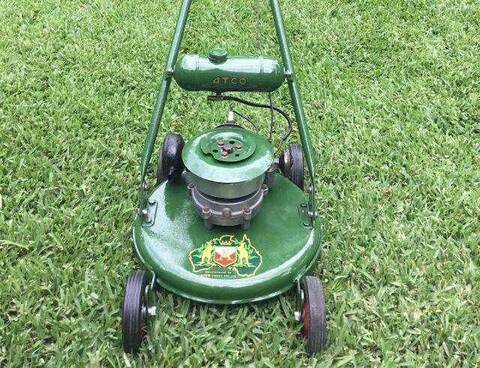
It looks to me as if the 4-hole flange on the crankshaft is neither on a taper, nor keyed on. If that is correct, it is probably a light interference fit on the shaft, and you would remove it by cleaning the rust and crud off the shaft, tapping it inward toward the flywheel slightly to break it loose (use a piece of tube or pipe that barely fits over the shaft) then pulling it off with a flat plate puller. It may be that only two of its four holes are currently used, but the remaining pair could be tapped to the same UNC size as the two that are already tapped. You could then make a very simple 4 hole flat plate puller and draw the flange off.
So far as the flywheel is concerned, Briggs lists 4 different flywheel pullers:
![[Linked Image]](https://www.outdoorking-forum.com.au/forum/uploads/usergals/2013/12/full-2772-13398-bs_pullers.png)
Here is the way the most common flat-plate pullers are used on flywheels pre-drilled with two holes:
![[Linked Image]](https://www.outdoorking-forum.com.au/forum/uploads/usergals/2013/12/full-2772-13399-bs_pullers_2.png)
Note that for the small engines the pre-drilled holes are ready for tapping with a 1/4" UNC thread.
Here is the corresponding instruction for some of the larger flywheels which look more like yours:
![[Linked Image]](https://www.outdoorking-forum.com.au/forum/uploads/usergals/2013/12/full-2772-13400-bs_pullers_3.png)
The manual notes that on the larger engines (22 to 28 cubic inches displacement), which require puller 19203, you can use a couple of cylinder head bolts in the puller:
![[Linked Image]](https://www.outdoorking-forum.com.au/forum/uploads/usergals/2013/12/full-2772-13401-bs_pullers_4.png)
Obviously if we had the engine model number, we could go straight to the correct instruction rather than posting a whole bunch of them like that. I'm guessing your engine may require the 19203 puller, after you tap the flywheel to suit cylinder head bolts. Essentially, the predrilled holes will probably turn out to be the correct tapping diameter for either 1/4" UNC, or the larger UNC thread for the head bolts. The size of the holes tells you which flat plate puller is required. It is the work of a moment to make up a flat plate puller by drilling two holes the required distance apart, in a piece of steel plate of suitable thickness.