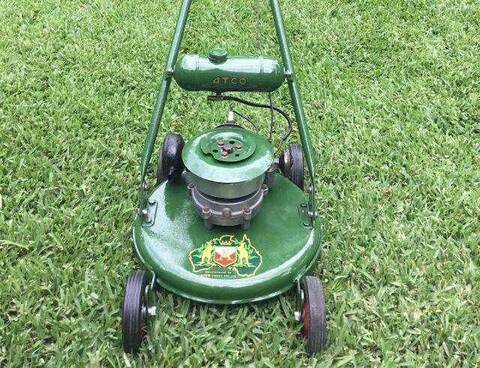
Paul, your blade sounds as if it has worn down rather a lot. That makes it impractical to penetrate very far into the ground, which is probably the reason you are not getting right down under your buffalo grass. I find I need to go one and a half to two inches below the surface of newly-mowed grass with either kikuyu or couch to cut right through the roots - I haven't tried buffalo, but it will be at least as bad. Sometimes I need to go deeper than two inches. However most of the blade wear comes from cutting dirt, not grass, so many (most?) users prefer to cut more frequently to a lesser depth, leaving the roots in place.
The blade does not need to be sharp to work properly. It will wear into a specific shape whatever you do, but the engine has more than enough power to do the job with square, flat edges on both leading and trailing sides. The blades wear fairly quickly if you cut right down below the roots, depending on how deeply you are cutting. However if you attend to the edges regularly you can form a sort of groove in the dirt that persists for a while.
The main frustration I have (apart from trying to cut around curves, which is slow and difficult) is that the edges of the concrete (paths, mower strips and curbs) are usually rather wavy and rough. I can only cut a straight line that touches on the high spots of the concrete. Couch in particular is prone to lurking in the low spots, sprouting again the moment I look away. The most practical solution seems to be a well-aimed dose of glyphosate after completing the rest of the edging process. However I've also found some benefits from a combination of a brick bolster in one hand and a sledgehammer in the other, to adjust the quality of the edge of the concrete. A large angle grinder with a masonry disk is then used for fine polishing.