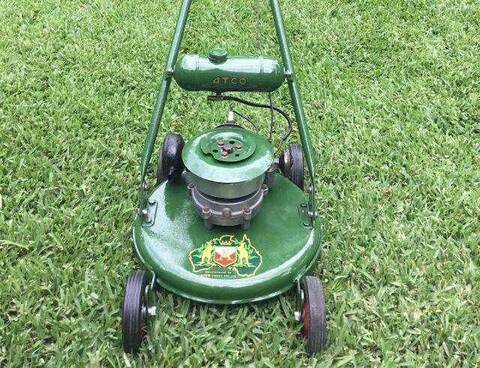
The Platypus Tool Company produced a range of reel mowers (electric & petrol) in Sydney from 1946 to the mid 1950s, possibly later. their registered office was at the infamous Wingello House, Angel Place, in the heart of Sydney�s CBD.
I say �infamous� because Wingello House (now demolished) is a story in itself. It once housed some of the most radical (far Right) political organisations in Australia, including the notorious New Guard. ODK members will probably know the name Francis de Groot, an antique dealer, who became involved with the New Guard and won notoriety by cutting the ribbon at the opening of the Sydney Harbour Bridge, 19 March 1932, in advance of the official party as a protest against the then Premier Jack Lang -- The dictionary of famous Australians.
That was over a decade before Platypus set up office in this building in the CBD. However, the first factory was at 17 Reservoir Street (near Central Railway Station), then Porter Street, Ryde, Sydney, and by the early 1950s they moved shop to Anzac Avenue, Ryde, Sydney.
Platypus sometimes stated in their ads that they were, "the first electric lawnmower to be manufactured in Australia". Clearly, that's puffery. Scott Bonnar preceded them with Australian reel electrics by almost two decades.
Nonetheless, the Platypus was a solid conventional design with a couple of unique features. Below I present the first advertisement I have from May, 1946; then March, 1949; then August, 1953.
Last edited by CyberJack; 29/11/1510:21 PM. Reason: Updated information.
PART TWO - Why the Name? I have asked that myself - why the name 'Platypus'? Their first machines were electric and electricity + mower hardly welcomes water . . .
That the Platypus Tool Company should name itself after a very odd and uniquely Australian water creature is of no accident. From the earliest days, the Platypus Company wanted to be identified as uniquely Australian. Many ads use �all Australian� and, �manufactured in Australia�, and �Sturdily built for � Australian conditions�.
This does make sense: Australia was an emerging nation and the 1940s produced the rudiments of those who did not suffer from �cultural cringe�, the term coined to describe the view that anything Australian was necessarily inferior to anything from Mother England.
A conscious attempt had been made to associate Mowers to Australian nationalism. I think that's an important sociological observation, because it precedes Victa in associating powered lawn mower advertising to this Nation.
Last edited by CyberJack; 01/03/1707:31 PM. Reason: Updated information.
PART THREE - Models: I have said that the first Platypus models were electric. Platypus made petrol machines in 2-stroke and 4-stroke variants. But by mid 1953 Platypus were advertising petrol models. They were powered by Iron Horse 4-stroke Horizontal shafts either made or branded as Coopers. [I do not know what brand was used for the 2-strokes.
PART FOUR - The Catcher & Edger When the convention for reel/roller machines was metal/wood or metal catchers, the Platypus used fabric. The patterned canvas catcher would have looked impressive on the showroom floor.
The Edger I want to include here a unique feature of the Platypus reel mowers. Offered as an accessory, it was a patented edger that attached to the side frame. It appears to have been an automated set of shears! [see below].
Platypus Tool Company as Ikea: It was in research that I discovered something else that Platypus did: Package Furniture. They sold pre-fabricated garden furniture of timber and steel construction.
Last edited by CyberJack; 01/03/1707:33 PM. Reason: Updated information.
PART FIVE - SIGNIFICENCE The reality is that Platypus mowers were, in most ways, ultra conservative. To put it politely, they looked �classical�; to put it impolitely, they looked old. By the 1950s reel mowers were looking modern � for examples: the Ransomes range; the Scott Bonnar range; the Greens range.
The Platypus looked old-worldly with its fabricated steel handles and frame. For Platypus, Ball bearings were still considered an extra in the 1950s! They did have a following though, and they sold in their thousands across Australia.
It is the old-worldly, classic look, combined with the quirky canvas catcher that makes these Australian machines collectable. It may be that we have under-estimated the desirability of the Platypus. The last one on eBay failed to sell, even at a fair price.
It is important that we remember Platypus mowers. They were an early Australian reel mower manufacturer - and they were proudly so.
The rest is history. --------------------------------------- JACK
PART SIX - SAFETY The role that vintage electric mowers played in Australia has been largely forgotten. I think there are a number of complex reasons for that and I hope to write something on that topic at some point in time...
Having said that, safety was an issue for electric mowers in the 1950s. A few widely-reported electrocutions (particularly of children) did not help the cause.
I was surprised to find one advertisement by Platypus, advertising a �Tueri Adaptor�. But while the headline said, �A Completely Safe Lawnmower� the smaller print revealed that this was an accessory � an extra � at a significant cost. That ad. is reproduced below:-
The Tueri Adaptor is a curiosity. The most startling thing I discovered about it and Platypus is that the company marketed it as a general consumer product to households:-
The poignant thing for me is that the message went unheard. It would take another half a century for household to be mandated with having this protection.
It could be argued that vintage electric mowers were robbed of their rightful place in vintage mower history.
It was the right product at the wrong time - mainly due to lack of government foresight and resultant lack of legislation.
Our Victa, ultimately, reigned supreme, not just because it was affordable, not just because it was light, but because it was not electric. It was SAFE ... well, as safe as a toe-cutter could be in the day.
The rest is history. --------------------------- Jack
UPDATE - 2017 - Brochure In early 2017 a Platypus brochure was sent to me by Grant Simpson. This was an exciting find � the only Platypus brochure known to exist!
Acknowledge and thanks to Warrick Hansted and Grant Simpson for the scanning and permission to use this important historical document.
The brochure itself presents as a trifold layout, produced (it would seem) by the Queensland agent, C & A Wilkey, of Queen Street, Brisbane. I date this brochure to about 1955 � because it does not include the Platypus rotary of 1956.
Interestingly, the brochure includes �The Platypus Story�. I think that story contains a couple of historical errors. The main one being the claim, �In 1944, they were markets both as electric and petrol-driven machines �. I am not sure about that � given wartime restrictions on the sale of lawnmowers. The earliest record I have for Platypus is from 1946; the earliest record I have for sale of petrol machines is from 1954 (not 1944).
Nonetheless, this brochure shows the 12�, 15�, 17� and 20� reel mowers in electric and petrol variants � including Brisbane prices! The brochure confirms that the Johnson Ironhorse 4-stroke design was made by the Cooper Engineering Company.



![[Linked Image]](https://www.outdoorking-forum.com.au/forum/uploads/usergals/2013/12/full-7392-13745-1946_05_cumberlandargus_15may_p3.jpg)
![[Linked Image]](https://www.outdoorking-forum.com.au/forum/uploads/usergals/2013/12/full-7392-13746-1949_03_sundaymail_20march_p4.jpg)
![[Linked Image]](https://www.outdoorking-forum.com.au/forum/uploads/usergals/2013/12/full-7392-13747-1953_08_sunherald_16aug_p16.jpg)
![[Linked Image]](https://www.outdoorking-forum.com.au/forum/uploads/usergals/2013/12/full-7392-13748-1953_01_sunherald_11jan_p12.jpg)
![[Linked Image]](https://www.outdoorking-forum.com.au/forum/uploads/usergals/2017/02/full-7392-33239-icon_external_link.jpg)
![[Linked Image]](https://www.outdoorking-forum.com.au/forum/uploads/usergals/2013/12/full-7392-13749-1954_11_sunherald_28nov_p56.jpg)
![[Linked Image]](https://www.outdoorking-forum.com.au/forum/uploads/usergals/2013/12/full-7392-13750-2013_11_chv_02.jpg)
![[Linked Image]](https://www.outdoorking-forum.com.au/forum/uploads/usergals/2013/12/full-7392-13751-2013_11_chv_13.jpg)
![[Linked Image]](https://www.outdoorking-forum.com.au/forum/uploads/usergals/2013/12/full-7392-13752-2013_06_platypus_ebay_03.jpg)
![[Linked Image]](https://www.outdoorking-forum.com.au/forum/uploads/usergals/2013/12/full-7392-13753-1953_06_sundayherald_28june_p4.jpg)
![[Linked Image]](https://www.outdoorking-forum.com.au/forum/uploads/usergals/2013/12/full-7392-13754-1950_08_sundayherald_13august_p10s.jpg)
![[Linked Image]](https://www.outdoorking-forum.com.au/forum/uploads/usergals/2014/09/full-7392-17519-1950_11_sundayherald_19november_p10s.jpg)
![[Linked Image]](https://www.outdoorking-forum.com.au/forum/uploads/usergals/2017/02/full-7392-33235-record.jpg)
![[Linked Image]](https://www.outdoorking-forum.com.au/forum/uploads/usergals/2017/02/full-7392-33238-platypus_electric_petrol.jpg)
![[Linked Image]](https://www.outdoorking-forum.com.au/forum/uploads/usergals/2017/02/full-7392-33236-brochure_platypus_thumbs.jpg)
![[Linked Image]](https://www.outdoorking-forum.com.au/forum/uploads/usergals/2017/02/full-7392-33237-brochure.jpg)
![[Linked Image]](https://www.outdoorking-forum.com.au/forum/uploads/usergals/2015/11/full-7392-25527-related_reading.jpg)
![[Linked Image]](https://www.outdoorking-forum.com.au/forum/uploads/usergals/2015/11/full-7392-25528-comment.jpg)