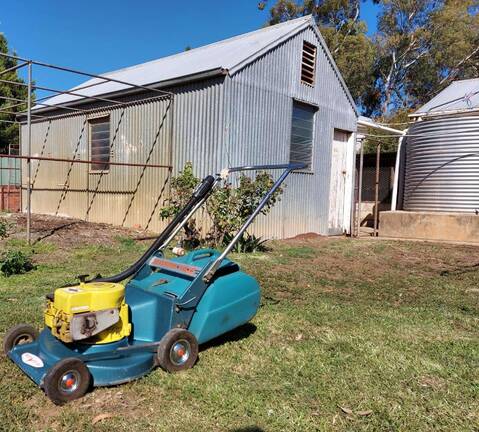
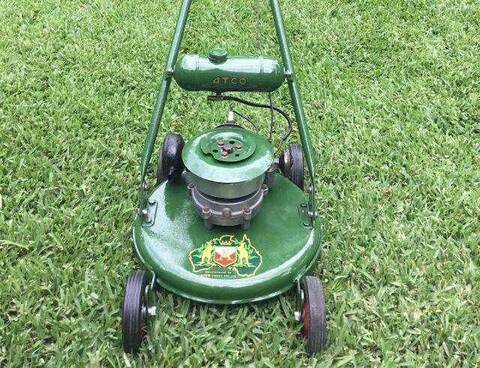
Thanks to Ian who put the word out there that this mower was looking for a new home. This is great unit the original owner was the foreman of the pattern shop at the Toowoomba Foundry. Mower is in excellent condition, missing the impulse starter and the fuel cap. Comes with another engine and a lot of spares including new gaskets and a piston complete with rings :-) his dad is still in Toowoomba and also has a workshop manual which he will post to me.
His son Mark tells me that his dad still has the patterns as well
i need to thank Ian Mathews for the tip off and also Mark who was so generous in giving me the mower and spares
It would appear that the SC rotary is a rare beast. I suspect this is mainly because the distribution network was largely agricultural - rather than domestic consumer.
The engines have always fascinated me. The historical significance lies in the fact that this was a manufacturer that made both engine and chassis.
I have a question: Paul's machine is a KXD2. Does this mean that the KXD1 was this machine:-
Hi Jack The mower you have shown is KX-C There was also a KX-A 2 stroke, KX-A 4 stroke, KX-B 4 stroke You have got me what does the '2' mean With sales of the SC mower the story goes like this SC made a 20" mower to be bigger than Victa BUT It was heavy and expensive to a Victa and SC decided to only to sell them through Southern Cross sales offices SO if there was no sales office in your area you never knew SC made a mower unlike Victa every mower shop every where had a Victa to sell Ian
It is amazing that such a 'classic style' was still being sold in 1970, apparently when this Garden Festival slide was taken. Perhaps beauty and the beast:-
it shows how important a distribution network is to sales. 1,000 per day was in '58 - when Boundy's mowers advertised they were selling 1,000 per week.
Southern Cross's failure to tap in to the horticultural market meant that they were pretty much just selling to the Ag sector.
Been asking a number of questions and The first proto kXD had no 2 on it, this mower dose survive The first production KXD had a 2 on Rob Laurent who wrote the book on Southern Cross machinery history does not know why the 2 What there is of the mower records are at the http://www.highfieldspioneervillage.com.au/ where Southern Cross has it's own display building and very worth while the visit anyhow there is no record of why the 2 As of interest the village has an opened shed full of mowers unrestored and some very nice ones there going to wast go and have a look Other Southern Cross records at State Library of Queensland https://www.flickr.com/groups/2938749@N23/ are only engine records which I have a copy of At this stage I more records than the village and the library So why the 2 you tell me and will both know Ian
I visited the Highfields Pioneer Village yesterday and it is well worthwhile, if you like all things old this is a great place. I had a special interest in the Southern Cross Museum and wasn't disappointed. All my photos are below, some are multiples but may be focused better etc
There was one of those villiers Southern Cross mowers with that 320-01 Pope on ebay a while back, I think there was another Southern Cross there too! Would have been a good buy.
That's fantastic stuff for the record. I do remain a little confused though.
The orange base machine appears to have a steel base, and a PTO unit at the back? andwith a clutch lever? This one was self-propelled! I wonder how that worked. Do we have a model number for it?
That's embarrassing for the Forum Historian What an exciting machine! I apologise to Ian for missing that post.
It uses a CVT for the belt and had differential action incorporated in the rear wheels, rather than the gearbox. This would not have been a cheap machine - probably over-engineered - but one that does indicate the sophistication of this little-know, or appreciated, Queensland manufacturer.
Hi Jack It's allright we all can't know everything all the time hehehe At the moment I'm at Maitland (NSW) for the steam fest this weekend When I get back home about a week I can send you the manual for that KXD drive unit Ian
I have a KXD4 which I inherited from my dad and am currently rebuilding. It still runs well for its age. Had a small oil leak which I have just fixed, also a couple of hairline cracks in the disc which I got welded. The wheels do not seem to be original and probably came off another old mower from around the same era, as they have red plastic hubcaps similar to the old Victa mowers, but without any brand name in the centre.
I have some questions that I hope other members can answer for me.
1) Can you still buy the original blades? I am currently just using standard Rover blades, with a custom-made bolt and washer.
2) What were the original brand and part numbers of the spark plug? I wasn't sure, so have just used a Bosch plug which sits neat with the head. It works, but it would be handy to know the original plug number.
3) Did the KXD4 have a recoil pull starter or a crank starter? My dad must have got rid of this at some stage and just put a pulley for a rope pull on the top. I am interested in buying the original starter if anyone has one available. Alternatively, would any of the old Victa cranks or recoil starters fit?
4) I am also missing the original air filter housing, so would be interested in purchasing one of these if anyone has one available. I am sure they are as rare as hens teeth though.
5) What method did they use to create that "ocean water" effect with the paintwork on the chassis and engine block? It is a blue-green colour and speckled or mottled if you look at it up close.
6) I'm looking for a copy of a manual if anyone can help.
I will post up some pics once I get it all back together!
Welcome, a KXD4. Are you able to post a pic of your mower, I am wondering what engine is fitted to that. I have a KXD2 which has the Southern Cross four stroke fitted.
I have never seen a set of blades to suit for sale
As best as I can work out the plug is an NGK B6HS
The paint is called hammertone or hammered finish
Not sure on the starter until I see your engine
Hope this helps, there is also a Facebook group for Southern Cross Engines and Machinery. Ian Matthews runs it and he can probably supply you with an electronic copy of the manual.
Thanks for the welcome Paul, and another big thank you for answering my questions. I knew that "honeycomb" paintwork would have to have a technical name. I am in two minds about getting my chassis repainted. I can ask a local spray painter if he can replicate it. Or maybe I should leave it the way it is. The paintwork really isn't that bad for its age.
I'll take a photo of the engine when I get time. Mine looks like the one 4 pictures back, with the recoil starter and the letters EC-BIG (or is it EG-BIC?) on the block.
Thanks for the info on the spark plug. My dad had just been using a small Rover plug, which is only half the length. The problem was the end of the plug hole had built up a big lump of carbon which had welded itself to the metal. I had to very carefully re-thread it.
I will check out the Facebook page.
I do have another question. I wonder why the early model had no hole in the front inspection plate, but on the later models they added a hole. I've wondered what the purpose of this hole is, other than provide a good place for hornets to fill with mud.
Hi Ian, No worries, the hole in the front is the crankcase breather. If you over fill the oil the engine will spray the excess oil out here, dual purpose :-)
Oh dear, I goofed badly on this one. After cleaning off the oil and gunk from the carriage, I discovered my mower is actually a KXD2 not a KXD4. I'm not sure why, but I had always thought it was a 4.
So I guess this means the correct crank for it is the wind up one?
Centre of bolt hole to centre of bolt hole is exactly 4" to mount a winder.
I will also need a new starter cap as the teeth are worn smooth. I am not sure if the one on mine is original or from a different mower. It has the letters "GED 139-2" and "HESS" stamped on the inside of the cap. It measures 3" 1/2 inch outside diameter, and 2" 3/4 inch inside diameter, and half inch centre hole.
I am also chasing a discharge chute, but I am sure an original will be near impossible to find. If anyone owns one, I would be very grateful for all of the measurements. Then I can try to make one that looks as close to an original as possible.


![[Linked Image]](https://www.outdoorking-forum.com.au/forum/uploads/usergals/2013/12/full-7423-13597-southern_cross_1ds.jpg)
![[Linked Image]](https://www.outdoorking-forum.com.au/forum/uploads/usergals/2013/12/full-7423-13598-southern_cross_3ds.jpg)
![[Linked Image]](https://www.outdoorking-forum.com.au/forum/uploads/usergals/2013/12/full-7423-13599-southern_cross_4ds.jpg)
![[Linked Image]](https://www.outdoorking-forum.com.au/forum/uploads/usergals/2013/12/full-7423-13600-southern_cross_5ds.jpg)
 on a very nice restoration there. Great pics.

![[Linked Image from i313.photobucket.com]](http://s313.photobucket.com/user/prc2008/media/20160302_160615_zpst50iojwk.jpg.html)
![[Linked Image from i313.photobucket.com]](http://s313.photobucket.com/user/prc2008/media/20160302_160625_zps15bktmbj.jpg.html)
![[Linked Image from i313.photobucket.com]](http://s313.photobucket.com/user/prc2008/media/20160302_160633_zpsbxpao7gd.jpg.html)
![[Linked Image from i313.photobucket.com]](http://s313.photobucket.com/user/prc2008/media/20160302_160710_zpsiymatfpt.jpg.html)
![[Linked Image from i313.photobucket.com]](http://s313.photobucket.com/user/prc2008/media/20160302_160722_zpszapawbic.jpg.html)
![[Linked Image from i313.photobucket.com]](http://s313.photobucket.com/user/prc2008/media/20160302_160726_zps0rrfwmix.jpg.html)

![[Linked Image]](https://www.outdoorking-forum.com.au/forum/uploads/usergals/2016/03/full-7392-27303-bruce_guppy_vm_01.jpg)
![[Linked Image]](https://www.outdoorking-forum.com.au/forum/uploads/usergals/2016/03/full-7392-27318-float_for_southern_cross_lawn_mowers_warana_festival_ca._1970.jpg)
![[Linked Image]](https://www.outdoorking-forum.com.au/forum/uploads/usergals/2016/03/full-7392-27399-1969_sc_catalogue_p59.jpg)
![[Linked Image from i313.photobucket.com]](http://s313.photobucket.com/user/prc2008/media/20160404_113739_zpsamzgvlil.jpg.html)
![[Linked Image from i313.photobucket.com]](http://s313.photobucket.com/user/prc2008/media/20160404_114307_zpsegrbex9h.jpg.html)
![[Linked Image from i313.photobucket.com]](http://s313.photobucket.com/user/prc2008/media/20160404_114545_zpswa71iwhz.jpg.html)
![[Linked Image from i313.photobucket.com]](http://s313.photobucket.com/user/prc2008/media/20160404_114554_zpsbhukyg0s.jpg.html)
![[Linked Image from i313.photobucket.com]](http://s313.photobucket.com/user/prc2008/media/20160404_114524_zpscafzonj1.jpg.html)
![[Linked Image from i313.photobucket.com]](http://s313.photobucket.com/user/prc2008/media/20160404_113541_zpsoqrcgmib.jpg.html)
![[Linked Image from i313.photobucket.com]](http://s313.photobucket.com/user/prc2008/media/20160404_113718_zps367glmm6.jpg.html)
![[Linked Image from i313.photobucket.com]](http://s313.photobucket.com/user/prc2008/media/20160404_120127_zpset0pedt6.jpg.html)
![[Linked Image from i313.photobucket.com]](http://s313.photobucket.com/user/prc2008/media/20160404_114345_zpsjwoevjgo.jpg.html)
![[Linked Image from i313.photobucket.com]](http://s313.photobucket.com/user/prc2008/media/20160404_114426_zpshfqkmshs.jpg.html)
![[Linked Image from i313.photobucket.com]](http://s313.photobucket.com/user/prc2008/media/20160404_114449_zps3mattgzp.jpg.html)
![[Linked Image from i313.photobucket.com]](http://s313.photobucket.com/user/prc2008/media/20160404_114926_zpsvl59pcg0.jpg.html)
![[Linked Image from i313.photobucket.com]](http://s313.photobucket.com/user/prc2008/media/20160404_114401_zpssb30rxco.jpg.html)
![[Linked Image from i313.photobucket.com]](http://s313.photobucket.com/user/prc2008/media/20160404_113818_zpspzzauhzs.jpg.html)
![[Linked Image]](https://www.outdoorking-forum.com.au/forum/uploads/usergals/2016/04/full-7392-27863-1964_11_westernherald_13november_p6.jpg)