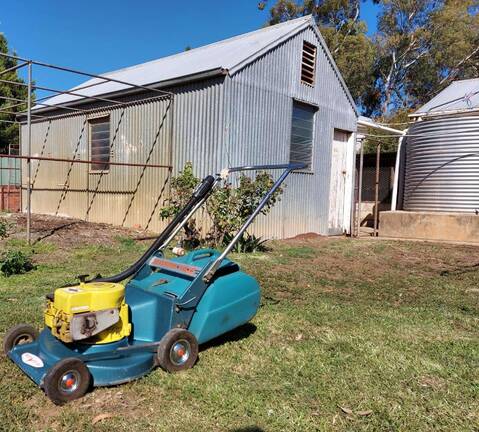
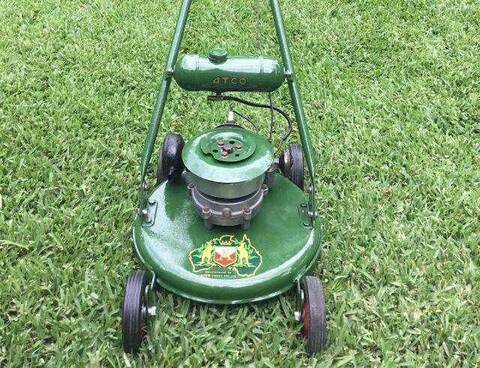
Can you please assist in identifying this B&S motor i have repainted all parts and have found no numbers at all the flywheel and magnetto numbers dont assit at all There is a number 5 on the ally casting on the flywheel side
Nice job on the resto and looks like you have a great workshop.
As to what it is to begin with I would hazard a guess saying its early 70s since you have the flass fuel bowl and updraught carby, since the output haft is fairly small I would be guessing at 2-4 hp as my 5hp one has a larger diameter output shaft and my 3hp has the same as what you have. Cheers Joe.
I have a 1963 6 cubic inch (60102), and it has a down-draft carburetor with the fuel tank underneath, like the Briggs of the following twenty or thirty years. The one pictured above has the same snap-down spark-plug-shorting device for stopping the engine, but the carburetor and gravity feed fueling look older than mine.
We might make a basic start with a few features. I guess you had the recoil starter off it, during the restoration. Does it have one sprag on the inner part of the over-running clutch, or five? (The sprags have inclined planes that the balls roll up to lock and engage the clutch. There are several balls and recesses on the outer part of the clutch on both early and later clutches. What changed is the number of sprag projections on the inner part.) Only early recoil-starter engines had a single sprag - my 1963 one does, but the old manual from prior to 1980 describes that kind of starter as the early type. Reference: http://www.tpub.com/content/recoveryvehicles/TM-5-4240-501-14P/css/TM-5-4240-501-14P_163.htm (Use the "back" and "next" features to see other pages.)
Seriously ancient (WW2 vintage) small Briggs engines had a spring-steel device that flexed to short the spark plug and stop the engine, instead of the pivoted lever that yours and mine have. The pivoted lever was a revision of that system, and later still they introduced the relatively modern kill wire system that operates on the magneto primary instead of the secondary.
I've attempted to attach a diagram of the small two-piece flo-jet, which seems to be the carburetor you have. It seems it may have still been in use at least into the 80s, on gravity-feed fuel-system engines. Can you tell us the bore and stroke of your engine? That could be a useful clue as to which type it is - at a minimum, it will give us the displacement in cubic inches, which on the older engines is the first digit of the type number.
Thanks for the link to the website as that gave me a lot of useful info I don't want to dismantle the engine to do the bore and stroke but the stroke is 1.5 in if that assists (measured via the spark plug hole)and from memory it was approx 2" bore
You might try this site: http://www.asecc.com/ The bore and stroke, and the "5" on the crankcase, would be consistent with it being an old Model 5, but it looks quite a bit different and I can't find any reference to them being made after 1957. That means it didn't have either a 5-sprag starter clutch or even a recoil starter. However if you fish around on that site you'll at least be entertained, if not enlightened. I think your engine was a successor to the Model 5S, but I think the 5S had a low fuel tank and a suction carburetor, like most of the 1960s, 70s and 80s small B&S engines.
Last edited by grumpy; 19/12/1001:39 PM. Reason: Add photo and detail.
You're welcome Marvic, I'm sorry I don't recognise the engine type. I've never actually encountered one of those very small (5 cubic inch, the smallest B&S engine size made in a very long time I think) gravity-fuel-feed engines. As I said, it seems to be a relatively recent successor to the 1950s small engines.
If you find the model number, please post it here - I'll leave this thread open.
Hi to Marvic and grumpy, I did some research and posted the pics on the ASECC website....This is the reply I received from Gary Stewart from Ohio:
"My guess is a 80300 series. The 8B etc had "B/S" stamped in raised letters on the shroud. The side cover is "different" with the casting below the bolt hole, and I don't remember seeing a gas tank bracket that was reinforced as this. This may be an exported engine and we just didn't see these here in the States. Hope this helps".
Hoping this does help,
Please do not PM me asking for support. Please post your questions in the appropriate forums, as the replies it may receive may help all members, not just the individual member. Kindest Regards, Darryl
There is something odd about his explanation, Deejay. An 80300 (i.e. an engine with the first generation of the five-digit code used by B&S from the late-1950s until the China expedition in the late 1990s) would have an 8 cubic inch displacement, whereas Marvic's engine is 4.7 cubic inches according to his bore and stroke figures. It sounds as if Gary Stewart was not aware of the bore and stroke. There were several different B&S 4.7 cubic inch engines in the 1940s and 1950s, with the Model 5 (and later the Model 5S) probably being the best known. The 5S had a vacuum carburetor instead of the older engines' gravity feed, and was made in larger numbers than the 5. It may have been the transition model, when B&S began to change their small light-duty engines to the vacuum carburetors and low fuel tanks that we are all used to. Marvic's engine indicates that after they made that transition they retained some gravity feed engines alongside the vacuum feed ones, perhaps for slightly heavier-duty applications. Marvic - from the pics it seems your engine has an aluminium cylinder - does it have a cast iron sleeve inside it, or an aluminium bore? The light-duty engines of the period had aluminium bores, and the heavy-duty ones had cast iron sleeves.
Hi grumpy, I will post this extra info....It may throw more light on it....someone must know what model it is, surely.
Please do not PM me asking for support. Please post your questions in the appropriate forums, as the replies it may receive may help all members, not just the individual member. Kindest Regards, Darryl
I think it is probably too easy for them rather than too hard, Deejay. I seem to have seen references to semi-modern 5 cubic inch engines somewhere. The bore is 2 inches and the stroke is 1.5 inches - both commonplace in very old B&S engines. You might mention that it has a 5 sprag starter clutch, not the old single sprag clutch.
Hi there It seems to have an alloy bore and from further inquiry MAy be off a type of cultivator . The motor hasent seen much use at all and shows no signs of any wear at all . Starts and runs real well
It's a nice piece of gear, Marvic, but I'd like to know what model it is, since I've never heard of it. Let's hope Deejay manages to find out from the ASECC collector group.
I hope to also know what model it is I have seen a photo of a morrison reel type of mower (old one) that seems to have the same motor from what i can make out . There is no detail of the motor that identifies it however, that i can see
Hi Marvic, I regret that I have no more info from the Antique Small Engine Group....my last post with more info has not received a reply....as one reply said, maybe that particular model was exported from USA and never used in that country.
Can you please post that pic of the Morrison reel mower that you have seen? Morrison is a New Zealand company that may have some records that may throw some more light on it. Please keep us posted.
Please do not PM me asking for support. Please post your questions in the appropriate forums, as the replies it may receive may help all members, not just the individual member. Kindest Regards, Darryl
Hi Marvic, It is an unusual Briggs, most of it looks like the original Briggs 3 HP that I had on my Scott Bonnar except for the petrol tank set-up..(mine was part of the carby set-up) Maybe one of our forum members may be able to shed some light on it... Thanks for posting the pic.
Please do not PM me asking for support. Please post your questions in the appropriate forums, as the replies it may receive may help all members, not just the individual member. Kindest Regards, Darryl
I don't know if it is 5 cubic inches like yours Marvic, but the layout looks the same (gravity fuel feed and small 2-piece flo-jet carburetor). Your engine would only be 1.5 or 2 hp - more likely 1.5. 1.5 hp is perhaps a bit small for even a reel type mower. The Morrison people do seem like a worthwhile group to talk to, though.
I lobbed up to my dads place earlier in the week and he had collected himself a small tiller. Whirlwind Homegardener.
The motor is similar to the one in the first post. Only difference is the glass bowl under the tank. Not sure what his had but if it had the bowl i would have noticed. Motor looks identical to the one above but its white. Same carb and the throttle mechanisim.
Number on the cowling was 60312 024202 that would make it a 2Hp, best i can work out.
Should have snapped a pic of it. I wrote dowm the number as i will have to chase some parts for it. It has been in the weather by the look of it, the head bolts on top and the spark plug are badly corroded. In the fuel tank is as clean as a whistle and it turns over fine.
Thanks for the info i also think its about 2HP . No help from the morrison people yet . it could be that it was a sample motor as someone suggested. i will use the numbers you have and check a few parts . its running like a new one and obviously hasnt had much use.
A 60312 is a 6 cubic inch, first generation design, horizontal crankshaft, plain bearing, rewind starter engine. Like the 60102 of great fame as a reel type mower engine, it is 2 hp. However marvic's 5 cubic inch engine (if his bore and stroke figures are correct) is unlikely to be as powerful. The 60102 is a vacuum carburetor engine. I have heard rumours of 6 cubic inch gravity fuel feed engines, though I haven't heard a type number for one before. A picture or two would be of interest, Bob, for the archives.
Will do Grumpy. The plan was to do a resto on the machine. So i will be looking for info.
I bought a Deutcher slasher for the old man last week. Well hashed out the deal and left a deposit. The guy had a small 3HP briggs horizontal that was hooked up to an air pump for diving. He couldnt get it started and did not want to sell it off like that on eBay. I got him to throw the motor in with the Deutcher deal.
Vacuum feed would be where the tank is under the carb. More common with vertical shaft woundnt it??? If the tank is on the other side of the engine that would be gravity feed wouldnt it???
The old man had a Mk10 stashed away in his shed too.


![[Linked Image]](https://www.outdoorking-forum.com.au/forum/uploads/usergals/2010/12/full-2864-110-001.jpg)
![[Linked Image]](https://www.outdoorking-forum.com.au/forum/uploads/usergals/2010/12/full-2864-111-002.jpg)
![[Linked Image]](https://www.outdoorking-forum.com.au/forum/uploads/usergals/2010/12/full-2864-112-003.jpg)
![[Linked Image]](https://www.outdoorking-forum.com.au/forum/uploads/usergals/2010/12/full-2864-113-004.jpg)




![[Linked Image]](https://www.outdoorking-forum.com.au/forum/uploads/usergals/2011/01/full-2864-427-154887956_full.jpg)