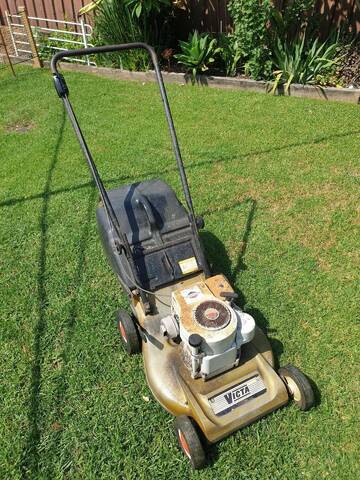
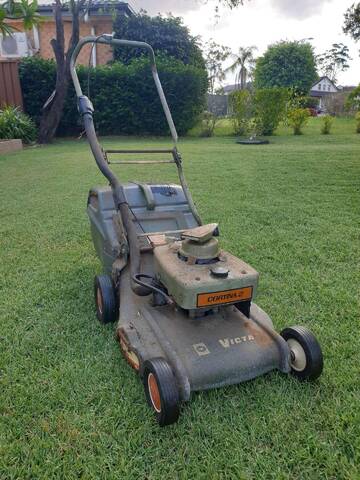
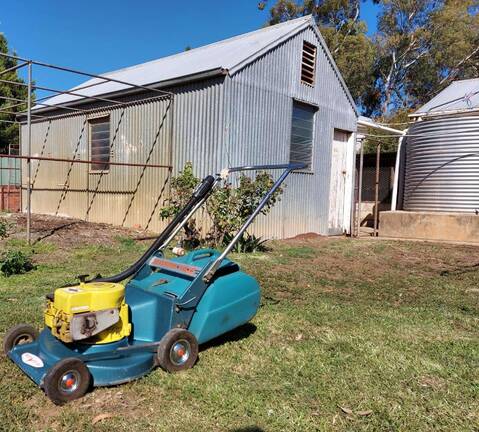
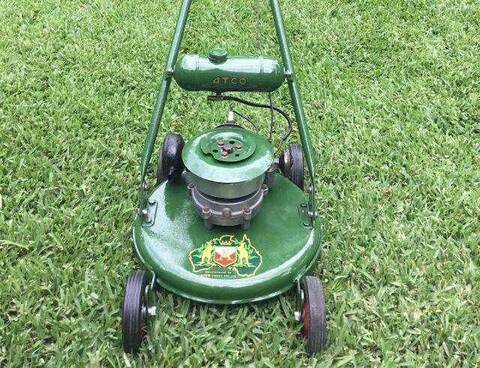
The Victa Powercut 82 volt mowers came with a lot of hidden design flaws. I am currently restoring my not-so-old Victa Powercut 82 volt to a more sensible and user friendly design, rather than bin it entirely.
First off they had a hopeless 82 volt engine that required a very expensive but inefficient Lithium battery. These only lasted around 12 months to 2 years, then would no longer hold their charge. Off to the bin with that. I'll replace it with a Briggs petrol motor and mount it on a standard Victa adapter plate.
Second flaw was the poor quality plastic wheels, worn out in no time and wobbling about like crazy. Into the bin with that rubbish. I'll replace them with some good solid bearing wheels.
Third stupid idea Victa had was the very thick blade disc that buries itself into the grass and hits or drags on any mounded areas of the lawn. The boss is a weighty two piece construction, which can be difficult to remove without bending it once the key rusts on to the shaft, as mine did.
The original long blades were bent upwards on a 90 degree angle, so the wind resistance forces the blades backwards and locks them in that position until nothing is making contact with the grass. A lot of people wondered why the blades weren't cutting and forked out money for new blades, only to find that the new blades made no difference. This was a truly dumb design. I'll get rid of that and replace it with a good old reliable Rover boss and disc, plus Rover blades. These are a lot cheaper to replace than the special Victa one.
These Victas were also prone to bulldozing in high grass due to the low "bulldog" front. I'll fix that by altering the engine height by adding the adapter plate, which will raise the entire cutting assembly considerably. Then on the lowest setting it won't get itself bogged down in the grass.
Another flaw is the lack of support in the cut out space around each wheel axle. The mild steel on the frame only has to get a bit bent, such as when a user runs into something. The axle is no longer locked in place and goes all wobbly or pops out entirely. So I've added some support bars across all four wheel positions of the axle to secure them and prevent them from ever popping out again.
They were a mulcher by design, so rust sets in in a few places. I stripped all of the plastic rubbish off the rear and binned it. Kept the mulch plug, as it might be worth a buck on eBay. Then ground out and treated the rusty patches under the deck. Modified the rear a bit to reinforce the frame, using mild steel which is a lot more solid than the original plastic!
The old Powdercoat paint was a pain to get rid of it, but I persisted with it. Will re-paint it and add some new labels, new wheels.
Handles were still in top condition but did suffer from another bad design fault. They relied on small hand tighteners to fasten the bars to the frame, which constantly come undone due to the vibration. I'll replace them with nyloc nuts for the lower part and only use the hand tighteners on the top part of the frame, where the fold is. I'll replace the small tighteners with larger ones. Will install some new foam for the top part of the handlebars. Binned the switch, wires etc. Will add a Rover throttle cable and throttle control.
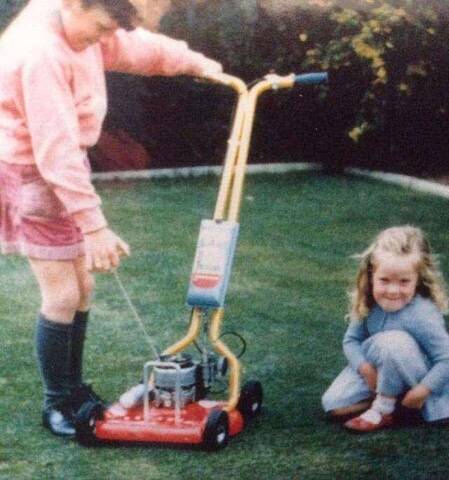
Here's what the Powercut 18" looked like when it was new. They were a nice-looking machine, but as I say, had many design flaws that only made themselves known after six months or so of operation. Most were sent to a very early grave in rubbish tips. I'd be surprised if many are still around.
Interesting how the overall look of the battery motor setup wasn't all that different from the petrol motor version - don't scare the customers with something too radical :-)
The great thing about it is if the battery fails or is too expensive to replace, you can just ditch the electric motor and replace it with a conventional 4 stroke Briggs. A Victa riser plate Part Number EN72957A is suggested for mounting a 70 mm shaft.
If you look after the batteries Vm they can last a lot longer.
The Victa 82V system is notorious for having a high-voltage, high-drain setup that cooks the internal cells. charging strategy. The "40/80 Rule" is the gold standard for extending the life of Lithium-ion (Li-ion) batteries.The "40/80" ScienceLithium batteries suffer from "voltage stress." Think of the battery like a balloon:Charging to 100%: It’s like blowing the balloon up until it’s ready to pop. The heat and high voltage cause chemical degradation.Dropping below 20%: This causes "deep discharge" stress. If a cell drops too low, the Battery Management System (BMS) might "brick" the battery permanently for safety reasons.How much longer will it last?If a standard Victa 82V battery lasts 2 years with "normal" (abusive) use (charging to 100% and running until it dies), here is what you can expect by shifting to a 40/80 or 20/80 cycle:Usage HabitEstimated Cycle LifeEstimated Calendar LifeStandard (0% to 100%)300 – 500 cycles1 – 2 yearsOptimized (20% to 80%)1,000 – 1,500 cycles 4 – 6 yearsThe "Golden" (40% to 70%)2,000+ cycles 7+ yearsNote: Because the Victa 82V system draws very high current (amps), heat is your biggest enemy. By staying in the 40–80% range, the internal resistance is lower, meaning the battery stays cooler while you mow.
40–80% just means when it's down at 40 percent charge you only charge to 80 percent , don't let it get below 40 percent and not above 80 percent.
The 82V Motor/Controller: In your Powercut, the motor and the electronic controller are often "potted" (sealed in resin) or sold as a single, incredibly expensive unit.
Planned Obsolescence: If a $5 capacitor on the control board blows, the official "Briggs" fix is to replace the entire $400 motor assembly. This "throwaway" culture is the opposite of what Victa stood for in the 70s and 80s.
Briggs & Stratton prioritized high-volume production. They wanted a mower that worked perfectly for the 2-year warranty period
Yes Max, it's all about the two year selling window within the warranty period these days, which is the reason why I suspect spare parts are often unavailable soon after the mower is released. I thought I might buck the trend of "throwaway culture" by fixing some of the design flaws on this one to make it last the distance. Problem of course is that Briggs have now also moved to the throwaway culture. The jury is still out on how long these new Chinese made Briggs 4-stroke engines are going to last.
As for Victa, I had a good laugh at the official video still on YouTube, made on the release of the Victa Powercut 82 V. The presenter boasted that the machine comes with "solid ball-bearing wheels"! I wonder if the presenter actually took the wheels off to take a proper look? I suspect not, because if he had he would have realised they are entirely plastic.
Hi vint-mow, Absolute garbage and a discrace to the original Victa name Plenty of 75 year old Toe Cutters are still around and some still being used on a regular basis $1000 at Bunnings is bloody thievery
Yes I agree Norm and Vm a lot of the newer models are kinda rubbish compared to the older models.
I've got a few 450E, 500E, and 550E series motors here with snapped cranks and no compression but look brand new on the outside even the oil inside looks new still.
Newer models are built with low quality materials as we know.
Yes Max, Anytime someone brings an "E" series Briggs to me the first thing I say to them is it is a heap of garbage but I will see what I can do with it for them. I have a quick check over it and most times I say bin it, even though they still look brand new. Only one word to describe them and that is GARBAGE
One motor I have found to be reliable and at $200 very good value they are the DMC 6.5 hp motors. I have fitted several to the Deutscher 22 inch slashers and never had a problem. Only issue I think with fitting them to a standard mower base is that they may be a bit heavy and they have a 25mm shaft so you would end up with a boss problem. This would be such a massive improvement over buying one of these $1000 pieces of Briggs garbage. Weight is my only concern
I haven't had any problems with the earlier "E" series motor made in USA. It's been going strong for probably 5-6 years now and has been put through some really high grass at full revs over 1/4 acre without losing compression. But now that they have transitioned to Chinese made, I do wonder. The Chinese made ones seem noisy to me and the latest sometimes misfires while running and backfires on stopping. So I wonder if they will live as long as the older USA stamped ones. DMC motors are mostly just generic Chinese Honda ripoffs too, aren't they?
vint_mow, I have fitted quite a number of those DMC motors and never heard of one giving any problems. I have fitted quite a few 14hp Chinese motors in rideons and never had a problem or complaint
China does seem to be getting better at manufacturing quality parts and machines. I suspect that might be why the prices keep going up. Before long it will no longer by economical to get things made there and as a result some manufacturing will return to Australia. I suspect we might be already seeing this trend with the return of Victa?