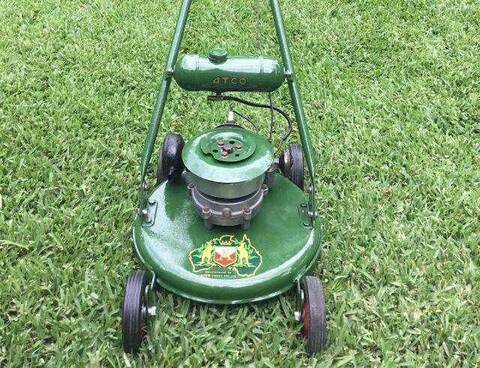
I have started a couple of threads on how to go about this but thought it better to put everything in here as I go along. It's taking me a while so it could be painstaking but time is scarce. Probably not helped by the fact it takes place at a friends residence who has the available space.
The story is that the Cox mower was a one owner which looked to be in excellent condition. It was owned by an elderly couple. The husband passed and the wife continued to use the mower without service and the failure was a combination of low oil and sloping ground.
The rod let go and there appears, to my untrained eye that there is very little associated damage. There is the slightest bruise on the crankpin hardened surface. You would have to wonder if that bent the crank. It is a spot about 1mm sq if that but it is a slight indentation into the hardened polished surface.
This is the remaining portion of the rod
This is the soup that came out of the casing
Armed with this paper. I chose 800 grade and found it to be more than suitable. I used only the one piece as I found when new it was easily abrasive enough and didn't want to take too much material away from the crank pin.
And this as a lubricant
In this fashion
Over time with careful application and patience I aimed to remove this aluminium deposit


![[Linked Image from i3.photobucket.com]](http://i3.photobucket.com/albums/y86/aldotalks/2012-03-25171439.jpg)
![[Linked Image from i3.photobucket.com]](http://i3.photobucket.com/albums/y86/aldotalks/2012-03-25171419.jpg)
![[Linked Image from i3.photobucket.com]](http://i3.photobucket.com/albums/y86/aldotalks/cleaningcrank3.jpg)
![[Linked Image from i3.photobucket.com]](http://i3.photobucket.com/albums/y86/aldotalks/cleaningcrank2.jpg)
![[Linked Image from i3.photobucket.com]](http://i3.photobucket.com/albums/y86/aldotalks/cleaningcrank1.jpg)
![[Linked Image from i3.photobucket.com]](http://i3.photobucket.com/albums/y86/aldotalks/crankpin1.jpg)
![[Linked Image from i3.photobucket.com]](http://i3.photobucket.com/albums/y86/aldotalks/crankpin2.jpg)
![[Linked Image from i3.photobucket.com]](http://i3.photobucket.com/albums/y86/aldotalks/crankpin11.jpg)
![[Linked Image from i3.photobucket.com]](http://i3.photobucket.com/albums/y86/aldotalks/crankpin10.jpg)
![[Linked Image from i3.photobucket.com]](http://i3.photobucket.com/albums/y86/aldotalks/crankpin9.jpg)
![[Linked Image from i3.photobucket.com]](http://i3.photobucket.com/albums/y86/aldotalks/crankpin8.jpg)
![[Linked Image from i3.photobucket.com]](http://i3.photobucket.com/albums/y86/aldotalks/crankpin7.jpg)
![[Linked Image from i3.photobucket.com]](http://i3.photobucket.com/albums/y86/aldotalks/crankpin6.jpg)
![[Linked Image from i3.photobucket.com]](http://i3.photobucket.com/albums/y86/aldotalks/crankpin5.jpg)
![[Linked Image from i3.photobucket.com]](http://i3.photobucket.com/albums/y86/aldotalks/crankpin3.jpg)