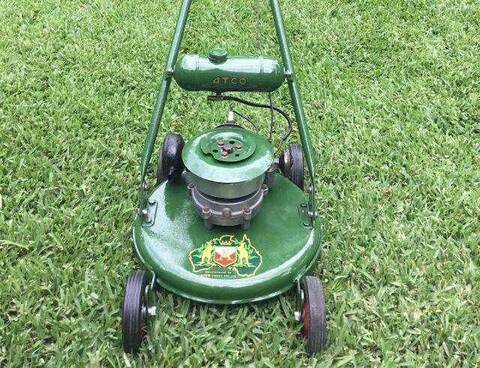
Just to add something that may be useful to anyone trying to ID a mower, heres dome info on the mowers in the photo, as they appear quite complete and original.
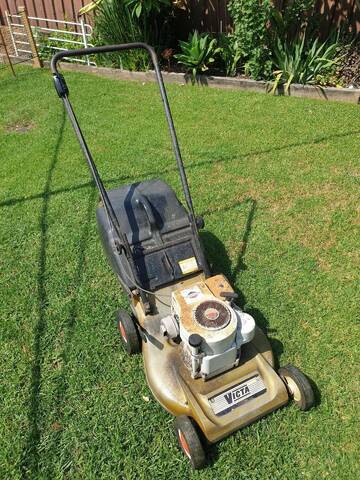
The first is a 1969 - 1971 V65 160cc Victa Corvette 2.
It is identifiable by the base (Sweeping ridges that curb around the engine) the Box Rocket Muffler, The Acute Point Handle Bar Tabs to release the handle bars, and the Impulse Starter.
The only non-original modification apparent in this picture is the reversion from the plastic The only modification i can see from this picture is the change of the plastic front plate (Where the sticker is on the front of the engine cowl) to the older metal type (the sticker is also the style for the older model) this is not uncommon, as the plastics often perish, and some people prefer the look of the metal. It is also visible that this piece was changed by the lack of rust damage to its chrome, as opposed to the chrome on the starter surround.
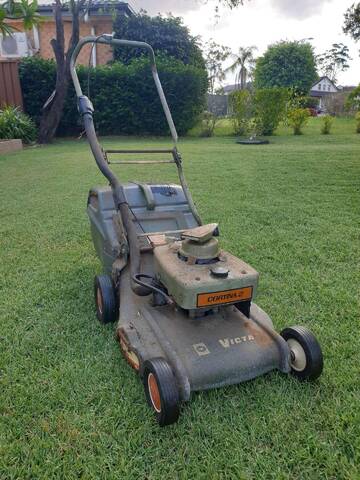
The second one would appear to be a model 530 Utility (V35 1965 - 1967) 3 models of utility had the combination of the early centrepiece-style handle bars (Like the 18" Special) the toe cutter base, and the rectangular tank on rectangular cowl. Of these 3, the first 2 had a small, round tube at the exhaust end of the muffler, instead of the flat exhaust outlet seen on this one, this exhaust only ren on the 3rd of these 3 Utility's, the 530.
This one appears to be original, apart from the air filter, which is of a different mower of a similar era, and the missing, sad face Victa badge (although the rivet holes for this badge are still visible in this pic.)
There is also an extra grass catcher in the picture, this (as above) is from either a VC-160 (any VC-160 Non Driven, they ran from 1970 - 1973, V80, V96 & V111) or the VC-125 (Either of the first 2, from 1971 - 1973, V97 & V112) it would not however fit the VC-160 Auto Drive, as this required a slightly modified catcher to accommodated the gear box.
It can be identified by the combination of the 2 separate Hanger pegs (Other catchers often had a solid plate across the catcher with the pegs on each end, as opposed to the 2 individual peg brackets) the cut-out at the front of the top (The flap is pulled up under this, and held in place by a long metal strap that requires the small notch seen near the Right lower corner of this cut-out) by the full length lower lip (hence not the auto drive) and by its shape overall, which is somewhat unique too.
Hope this information is useful to someone one day, trying to identify and date a mower.