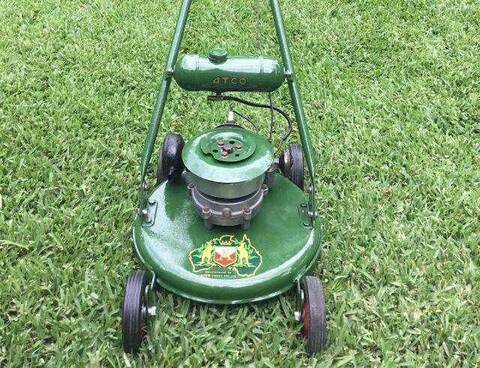
It certainly looks as if it was run on straight petrol. If you hone (or more likely bore) the scores out of that cylinder bore you'll need a bigger piston. The piston you've got is scrap, but taking piston and cylinder from a scrapped mower seems like it should be much cheaper than $70 (if you live in a town or city, probably $70 cheaper).
I'm not happy with some parts of Bob's cure. I don't like grit in the engine, because it's a recipe for rapid wear. One question is whether there are metal particles in the big end bearing: you need to get that clean. Another of Bob's methods I don't support is trying to clean out piston ring grooves with a screwdriver. I've been there and done that, and the result was ring groove lands that were no longer square to the bore. I use - and recommend - a piece of one of the old piston rings. Break off a piece about a third to half of the circumference of the bore, so you have something to hold onto, and carefully grind the end square to the ring. Use it carefully as a scraper. With four stroke pistons, which don't have pegs in the ring grooves, my favourite method is to hold the piston in a lathe chuck and use the piece of piston ring as a hand-held parting tool. (Pack the piston so the chuck jaws don't touch it, of course, and use a negligible clamping pressure, or make a simple adaptor that holds the piston via a pin through the gudgeon pin hole.) If you have a lathe an even better method is to make a suitable parting tool and use that, but I've never bothered. Whatever method you use, do not remove any metal from the ring groove of course: not even a tiny amount.
Other than that, just doing a mix-and-match of parts from a wrecked mower seems like a cheap, easy fix. You even end up with a full set of parts to draw on, so whenever you find a worn bit, you just take the better one from the other mower and avoid both a trip to the mower shop, and any expense. There is one point I agree with Bob on: this isn't a Briggs and Stratton, let alone a car or motorcycle engine: it's a Victa 2 stroke, so it does not require the detail and care in fitting parts that you would apply to a "real" engine.